Why Skincare Products Pill: Application, Layering and Troubleshooting
Troubleshoot rolling skincare particles by identifying the step, simplifying optional layers and checking application while preserving sunscreen coverage.
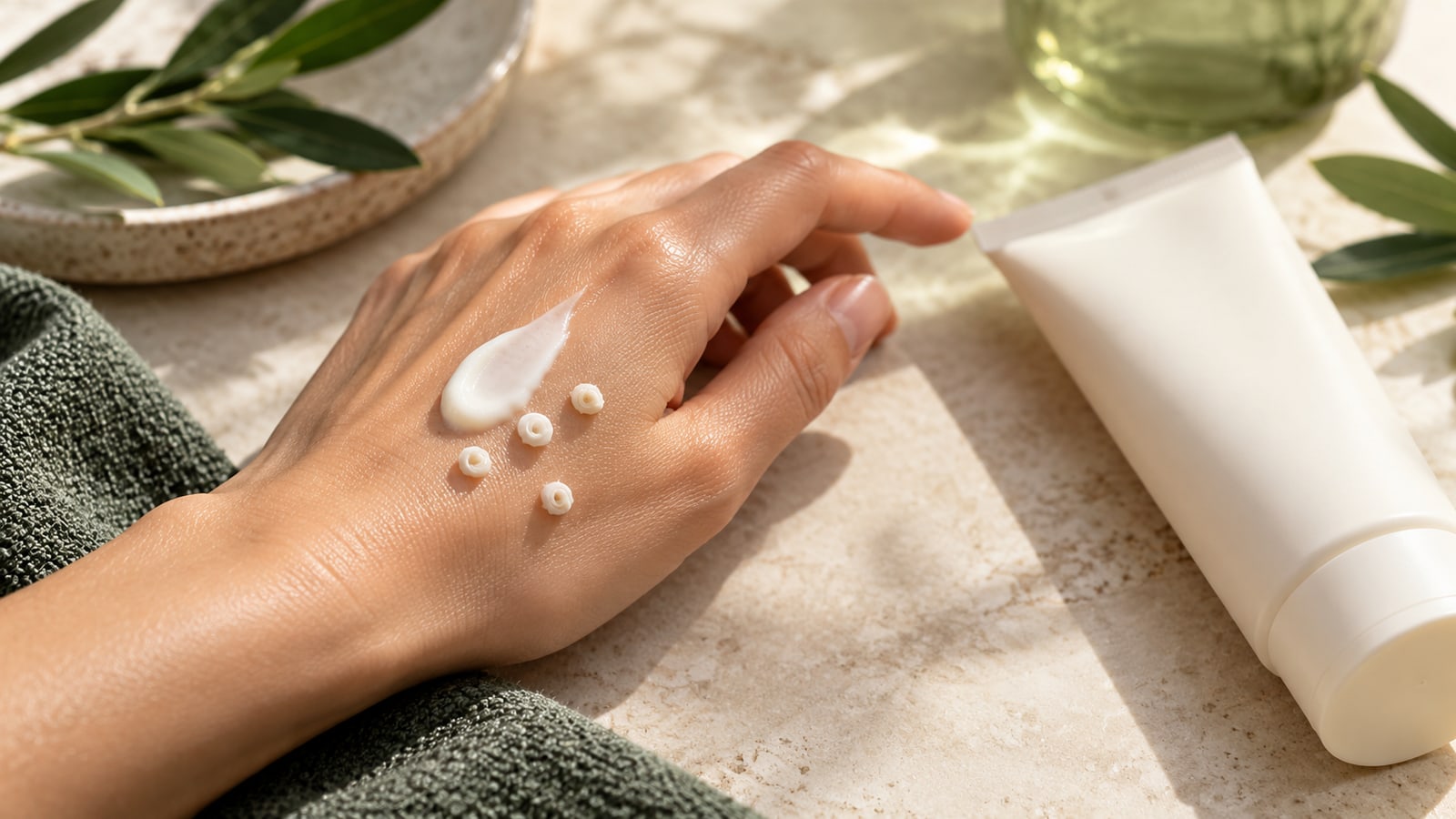
Skincare pilling happens when product forms small rolls or flakes on the skin during application. It can be frustrating, especially when sunscreen or make-up seems to lift as you add the next layer. The particles are not automatically dead skin or proof that you need stronger exfoliation.
Pilling can involve the products, the skin and the way layers are applied. A useful troubleshooting approach changes one variable at a time while preserving important steps such as adequate sunscreen use and prescribed treatment.
Key takeaways
- Pilling is product rolling into particles during application.
- It is not automatically a diagnosis of dry skin or allergy.
- Formulation, layering and friction may contribute.
- Do not reduce sunscreen below its recommended amount to hide pilling.
- Persistent peeling, soreness or a rash needs a different assessment.
On this page
- First identify when it happens
- What research can currently tell us
- Reduce unnecessary layers before changing essentials
- Follow each product’s intended amount and method
- Allow the routine to settle without inventing a timer
- Locate, simplify, adjust, reassess
- Protect the sunscreen step
- Do not mistake irritation for a formulation puzzle
- Common questions
- Sources and further reading
First identify when it happens
Notice the step at which particles appear: while applying moisturiser, after sunscreen or when blending foundation. Record which products were underneath and whether the skin was still wet from washing or another layer.
You do not need a detailed daily log. A short note can help you avoid replacing the wrong product. If pilling only occurs with one combination, that is a more useful clue than deciding that an entire ingredient category is unsuitable.
Check whether the particles are linked to rubbing on a product or whether the skin is peeling before you begin. Ongoing flaking, pain or inflammation should not be treated simply as a cosmetic layering problem.
What research can currently tell us
A 2024 study in Skin Research and Technology examined pilling during sunscreen and foundation layering in 528 women aged 20–49 in Guangzhou. It found associations with skin characteristics and application methods, with rubbing producing more pilling events than some other methods tested.
The study provides useful clues, but its population, products and test conditions do not represent every routine. It does not establish a universal ingredient blacklist or show that all sunscreens pill. The research also had cosmetics-industry funding, which is relevant context when reading the findings.
For everyday use, the practical inference is modest: application and the particular combination may matter. Do not turn one study into a rule that everyone must stop rubbing all products or add foundation to correct sunscreen.
Reduce unnecessary layers before changing essentials
List the products used in the routine and identify their purpose. If several optional serums or primers serve similar cosmetic goals, try simplifying those first. Keep prescribed care unchanged unless the responsible clinician advises otherwise.
Our guide to a simple skincare routine helps distinguish core needs from optional extras. Removing an unnecessary layer may be easier than buying a new version of every product.
Test a simpler combination on an ordinary day when you have time to notice the result. Avoid experimenting immediately before an important event, when the pressure to fix the appearance can lead to more rubbing and more product.
| Observation | Useful check | Shortcut to avoid |
|---|---|---|
| Pilling after several optional layers | Try a simpler routine | Replacing every product at once |
| Pilling during heavy rubbing | Review the application method | Scrubbing particles away repeatedly |
| Sunscreen rolls off | Check compatibility and even application | Using too little sunscreen |
| Skin peels before products are applied | Consider irritation or another skin problem | Assuming more exfoliation is required |
Follow each product’s intended amount and method
Check whether a product is meant for damp or dry skin and how much the label recommends. A rinse-off product left behind can complicate the next step. A thick application of an optional cosmetic may also behave differently from the intended use.
Do not use a universal rule such as “always use half as much” across the routine. Sunscreen and medicines have specific application requirements. Adjusting an optional layer is a different decision from under-applying a protective or prescribed product.
Our guide to product order explains how directions and treatment needs take priority over an elaborate layering chart.
Allow the routine to settle without inventing a timer
If you are applying the next product while the previous layer is still visibly wet or moving around, try allowing it to settle in line with the instructions. There is no single waiting time that makes every combination compatible.
Be gentle when applying later layers and avoid repeatedly working the same area after the product has begun to set. At the same time, follow sunscreen directions for spreading it evenly; a pilling workaround should not leave uncovered patches.
If the problem persists, ask the manufacturer about the combination or try a different compatible formulation when practical. You do not need to infer incompatibility solely from whether the first ingredient is water or a product contains silicone.
Locate, simplify, adjust, reassess
- Locate: Identify the step where particles first appear.
- Simplify: Remove unnecessary cosmetic layers.
- Adjust: Follow directions and reduce avoidable friction.
- Reassess: Check comfort and adequate protective coverage.
Protect the sunscreen step
The American Academy of Dermatology emphasises using enough sunscreen and distributing it properly. A routine that looks smoother only because much less sunscreen is used is not a good solution.
Johns Hopkins Medicine similarly notes that most people under-apply sunscreen and discusses fitting it into a morning routine. If a combination consistently causes product to roll away, consider simplifying the layers beneath it or choosing another suitable formulation rather than accepting unreliable coverage.
Our guide to sunscreen labels explains the protection information to preserve. Continue using shade and protective clothing as appropriate rather than treating sunscreen as the only measure.
Do not mistake irritation for a formulation puzzle
If skin is sore, persistently itchy, burning or visibly inflamed, stop the suspected product and seek advice when needed. Pilling itself does not establish allergy, but a reaction occurring alongside it should not be ignored.
Avoid adding scrubs or strong acids simply to remove particles. They may introduce another problem while leaving the original product interaction unresolved. A calmer, simpler routine and a clear account of what happened are more useful starting points.
Keep expectations proportionate. Occasional cosmetic residue is inconvenient, but it does not mean your skin is failing or that you need a complete new collection. Aim for a routine that is comfortable, practical and used as intended.
Common questions
Are the rolled particles always dead skin?
No. They may be product collecting into small particles during application.
Does pilling prove an allergy?
No. A rash or persistent discomfort needs a separate assessment.
Should I exfoliate more?
Not automatically. First identify the products and step involved.
Can I use less sunscreen to stop it?
Do not under-apply sunscreen. Adjust optional layers or consider another suitable formulation.
Is silicone always the cause?
No. A universal ingredient explanation is not supported for every routine.
Must I wait a fixed number of minutes?
No single interval suits every product; follow instructions and let layers settle appropriately.
Should I replace the whole routine?
Start with one change so you can understand what helps.
What if peeling happens before skincare?
Consider a skin problem or irritation rather than assuming it is product pilling.
Sources and further reading
Sources checked 22 October 2026. The pilling study’s population and industry funding are noted; no universal compatibility rule is inferred.
Keep exploring
Soap Bars and Syndet Bars: Understanding the Formulation Difference
Understand how soap and syndet bars differ, why format and foam do not define gentleness and when dry or eczema-prone skin needs specific washing advice.
Cleansing Balms and Oils: Emulsifying, Rinsing and Product Residue
Use cleansing balms and oils as intended by checking dry or wet application, emulsifying, rinsing and residue without prolonged rubbing.

Double Cleansing: When a Second Cleanse May Be Useful
Assess whether a second cleanse adds value to your routine, with practical guidance on resistant make-up, product choice and avoiding over-washing.
Micellar Water: Should You Rinse It Off After Cleansing?
Decide whether to rinse micellar water by checking the product directions, make-up removal needs, residue and skin comfort rather than a universal rule.