Tinted Sunscreen: Shade Matching, Iron Oxides and Visible-Light Claims
Compare tinted sunscreen by UV protection, iron oxides, shade fit and application amount, with clear limits on what melasma research can establish.
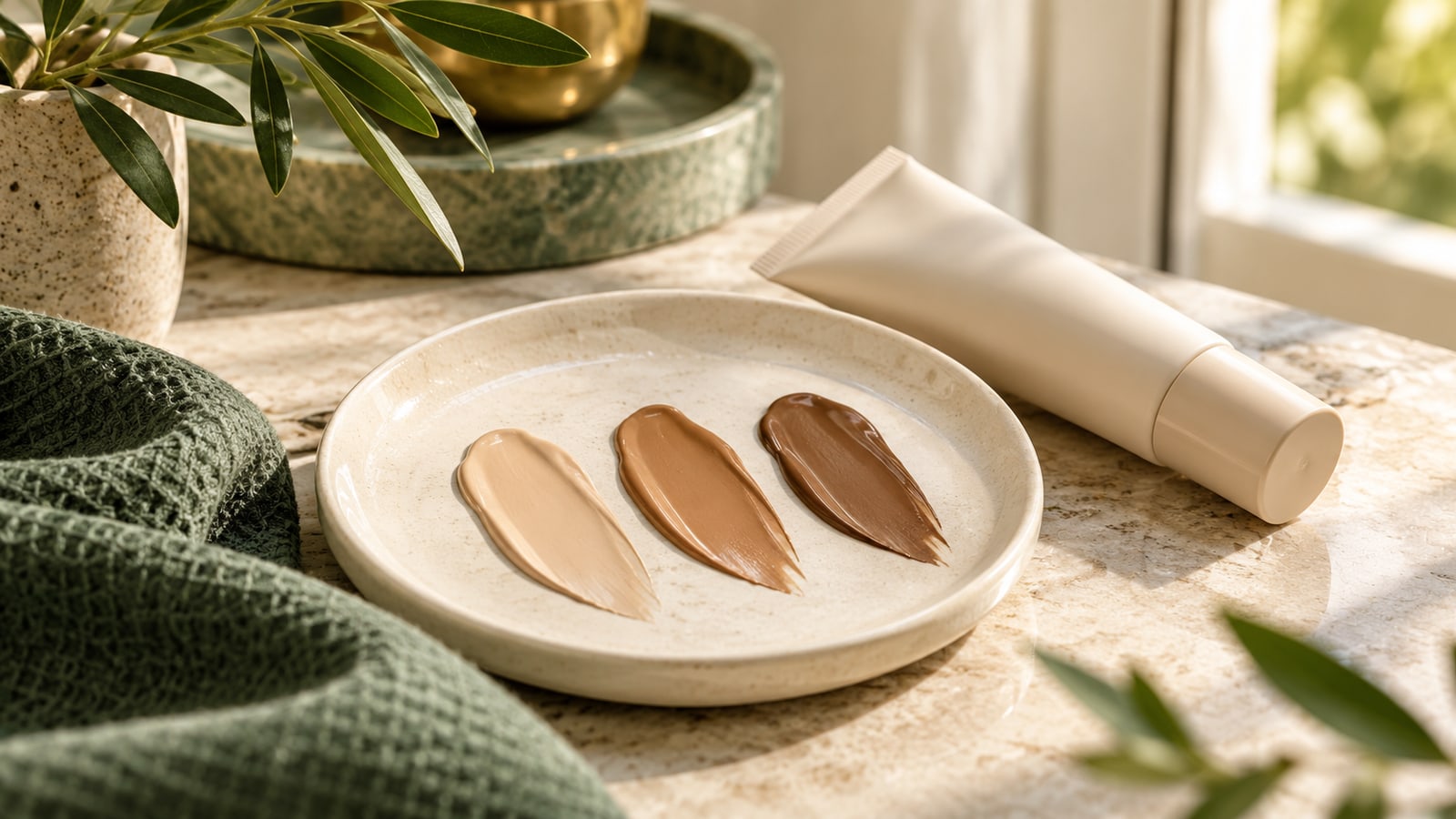
Tinted sunscreen can combine sun protection with a cosmetic tint, but choosing one involves more than finding a colour that looks attractive in the bottle. The protection label, the amount you can comfortably apply and the way the shade looks on your own skin all matter.
Iron oxides in some tinted formulas are also relevant to visible-light protection and pigmentation. That is a specific reason to consider a tint, particularly in a clinician-led melasma plan; it is not a promise that every tinted product treats dark marks.
Key takeaways
- Check SPF and UVA protection even when the tint looks ideal.
- Iron oxides can help provide protection against visible light.
- Evidence from a particular formulation does not establish identical performance for every tint.
- A useful shade should work at the intended application amount.
- Tinted sunscreen supports protection; it does not diagnose or cure pigmentation.
On this page
- Separate three different questions
- Why iron oxides are discussed
- What a melasma trial can and cannot establish
- Test shade at a meaningful amount
- Avoid turning shade adjustment into a formulation experiment
- Check, match, apply, review
- Keep the wider protection plan
- Common questions
- Sources and further reading
Separate three different questions
Ask whether the product provides suitable UV protection, whether it has relevant visible-light protection information and whether its colour works for you. These questions overlap in a finished product, but none can be answered solely by looking at the colour of the cream.
Our sunscreen-label guide covers SPF, UVA information and water resistance. Keep those checks in place rather than treating a tint as a shortcut around them.
A useful shopping note might list your required protection, preferred finish and shade constraints in separate lines. This makes it easier to compare two products without letting attractive packaging or an appealing shade name dominate the decision.
Why iron oxides are discussed
The American Academy of Dermatology explains that visible light can worsen dark spots and that tinted sunscreen containing iron oxide can help protect against it. This is an additional consideration beyond simply choosing a UV-protection number.
Read the product information rather than assuming that any beige cosmetic offers the same performance. A tint can be included for appearance, and the presence of a familiar ingredient name does not tell you every detail of the finished formulation’s testing.
If visible-light protection is important in your treatment plan, ask your clinician or the manufacturer what information supports a particular product. It is reasonable to ask a precise question instead of trying to calculate protection from an ingredient list.
What a melasma trial can and cannot establish
A randomised trial published in 2014 compared UV-only sunscreen with a UV-and-visible-light sunscreen containing iron oxide. It enrolled 68 people with melasma, and 61 completed the eight-week study. Both groups also used a depigmenting treatment.
The group using UV-and-visible-light protection had better pigmentation outcomes. However, the trial involved specific products, a defined period and accompanying treatment. It does not show that a tinted sunscreen alone cures melasma or that every product advertised as tinted will reproduce the result.
Our guide to melasma explains why diagnosis and realistic treatment expectations matter. Bring the sunscreen you are considering to an appointment if you want help fitting it into an existing plan.
| Feature | Useful information | Do not assume |
|---|---|---|
| SPF and UVA label | The stated UV protection and directions | That colour replaces protection information |
| Iron oxides | A relevant ingredient for visible-light protection | Identical performance in every formula |
| Shade and undertone | How the intended amount looks on your skin | That a tiny blended swatch reflects full use |
| Clinical evidence | Which product and population were studied | That a study proves a universal cure |
Test shade at a meaningful amount
A very thin swatch can disappear beautifully while a proper application looks too pale, too orange or too dark. If a sample is available, assess the product using its intended directions before committing to a large purchase.
Look in ordinary daylight as well as the lighting where you usually apply skincare. Consider the transition to your neck and the areas you actually expose. A photograph can help you remember an obvious mismatch, but camera processing is not a reliable measure of protection or an exact colour standard.
Do not make the shade work by consistently applying too little. If the available colour range does not suit you, that is a limitation of the product choice rather than a problem with your skin tone.
Avoid turning shade adjustment into a formulation experiment
It can be tempting to mix foundation, moisturiser or another tinted product into sunscreen to improve the colour. Unless the manufacturer specifically supports that use, the resulting mixture has not automatically inherited the original product’s tested performance.
A more practical starting point is to find a suitable sunscreen and then consider separately applied cosmetics. Our guide to sunscreen under make-up addresses that sequence and the need to preserve adequate coverage.
If you cannot find a comfortable tinted option, discuss alternatives rather than abandoning UV protection while searching for a perfect match. A clinician can help prioritise your particular pigmentation concerns.
Check, match, apply, review
- Check: Read UV protection and relevant visible-light information.
- Match: Assess the shade at the intended amount.
- Apply: Follow directions without diluting the product.
- Review: Consider comfort, reapplication and your treatment plan.
Keep the wider protection plan
NHS sun-safety guidance includes shade, clothing and appropriate sunscreen, with reapplication during exposure and after activities that remove it. A tint does not remove those needs.
Think about how a second application will look and feel before a long day outdoors. Pack what you need and allow time for touch-ups. If repeated layers become uncomfortable, review the product choice rather than stretching the first application beyond its instructions.
Finally, do not assume every dark patch is melasma. New, changing or unexplained pigmentation deserves appropriate assessment. Comparing tint shades cannot answer a diagnostic question, even when the cosmetic coverage temporarily makes a mark less visible.
Common questions
Does every tinted sunscreen contain iron oxides?
Do not assume so; check the ingredients and the manufacturer’s protection information.
Does a darker tint mean a higher SPF?
No. Read the stated SPF and UVA information instead of judging by colour.
Can tinted sunscreen cure melasma?
No such guarantee follows from the evidence; protection may form part of a broader treatment plan.
Why try a sample?
It helps you assess shade, feel and appearance at the intended application amount.
Can I thin it to improve the match?
Do not under-apply or dilute a protective product to solve a colour mismatch.
Is foundation automatically equivalent?
No. Its application amount and protection information may differ substantially.
Does the tint remove reapplication needs?
No. Follow the sunscreen directions and account for swimming, sweating and removal.
What if none of the shades suits me?
Keep suitable UV protection and ask about alternatives that fit your skin and pigmentation plan.
Sources and further reading
Sources checked 22 October 2026. The melasma trial’s accompanying treatment and limited generalisability are stated.
Keep exploring

Sunscreen Under Make-Up: Applying Both Without Relying on SPF Cosmetics
Apply sunscreen beneath make-up with adequate coverage, manageable layering and a practical reapplication plan rather than relying on light SPF cosmetics.
Why Skincare Products Pill: Application, Layering and Troubleshooting
Troubleshoot rolling skincare particles by identifying the step, simplifying optional layers and checking application while preserving sunscreen coverage.

Soap Bars and Syndet Bars: Understanding the Formulation Difference
Understand how soap and syndet bars differ, why format and foam do not define gentleness and when dry or eczema-prone skin needs specific washing advice.
Cleansing Balms and Oils: Emulsifying, Rinsing and Product Residue
Use cleansing balms and oils as intended by checking dry or wet application, emulsifying, rinsing and residue without prolonged rubbing.