Peptides in Skincare: What the Research Does and Does Not Show
Assess peptide skincare claims by formula, route and study design, and understand why supplement research does not automatically prove a serum works.

Peptides appear in many skincare products, often alongside claims about collagen, firmness and repair. The name describes a broad group of ingredients, not one treatment with a single proven effect. A useful assessment starts with the exact peptide, the complete formula and the evidence behind the particular claim.
There are promising findings, but the research does not justify treating every peptide serum as equivalent or assuming that results from supplements apply to creams. This guide explains what to look for before adding another product to your routine.
Key takeaways
- Peptides are chains of amino acids with different structures and potential functions.
- A laboratory finding is not the same as a demonstrated benefit from a finished cosmetic.
- Oral supplement studies should not be treated as direct evidence for topical skincare.
- Individual trials apply to the tested formula and comparison, not every peptide product.
- A simple, comfortable routine remains a reasonable choice without an additional serum.
On this page
- What does the word peptide tell you?
- Separate mechanisms from clinical results
- Do not merge oral and topical evidence
- Read individual trials in context
- Remember the rest of the formula
- Decide whether the product has a clear purpose
- Keep tolerance and treatment instructions in view
- Make a proportionate decision about cost
- Common questions
- Sources and further reading
What does the word peptide tell you?
Peptides consist of amino acids linked together. Their sequence and structure can differ, so the category includes many substances rather than one interchangeable ingredient. Research reviews discuss different proposed roles and the challenges of delivering cosmetic peptides through the skin.
The ingredient name alone therefore does not establish a predictable result. Two products described as peptide serums may contain different ingredients, concentrations and supporting formulas. Even a shared peptide name does not prove that the complete products perform identically.
Read the claim carefully. Softening the feel of dry skin, changing an instrument measurement and reducing the visible appearance of a wrinkle are different outcomes. A broad phrase such as skin renewal should prompt a question about what was actually measured.
Separate mechanisms from clinical results
A laboratory experiment can investigate how a substance affects cells or a biological process. That can help researchers decide what to study next. It does not show, by itself, that a commercial product produces a noticeable benefit when applied in ordinary use.
Formulation, stability and delivery matter. So do the people included in a study, the comparison product and the length of follow-up. A scientific diagram on a product page is not a substitute for those details.
Ask whether the evidence concerns an isolated ingredient, a research formula or the exact product being sold. That single distinction can make an apparently impressive claim easier to interpret without requiring you to become a cosmetic chemist.
Do not merge oral and topical evidence
A systematic review of 19 randomised trials included predominantly oral peptide interventions, with only two topical studies. It reported some favourable outcomes but also substantial differences between formulations and outcome measures. Its authors noted the limited representation of topical skincare.
That imbalance matters when a cosmetic advertisement cites a large combined participant total. Most participants may have taken a supplement rather than applied a cream. The findings cannot simply be reassigned to every topical product bearing the word peptide.
This guide does not recommend taking a supplement to obtain a skincare result. If a product claim relies on oral research, ask for evidence relevant to the route, formula and outcome you are actually considering.
Read individual trials in context
A 2025 randomised trial studied a particular cyclised hexapeptide-9 serum, a low-concentration retinol comparator and a vehicle serum in 96 Asian participants. Some measured outcomes favoured the peptide formula. That is evidence about those tested products and participants, rather than proof that all peptides outperform all retinoids.
The comparator is especially important. A result against one concentration in one formula cannot establish a ranking against every prescription or cosmetic retinoid. It also cannot tell you whether your own skin would tolerate or benefit from the product.
Look for the size of the difference as well as whether it was statistically significant. Ask whether the change was noticeable to participants and how long it lasted. A positive headline can omit details that matter to an ordinary purchasing decision.
| What the claim mentions | What to check | Why it matters |
|---|---|---|
| Collagen or cell activity | Laboratory study or human product trial? | A mechanism does not establish visible benefit |
| A large review | How many studies involved topical products? | Supplement findings may dominate the result |
| Better than another ingredient | Exact comparison formula and concentration | One trial cannot rank whole ingredient categories |
| Clinically tested | Outcome, control group and follow-up | The phrase alone does not explain study quality |
Remember the rest of the formula
A peptide product may also contain moisturising ingredients. If skin feels softer after application, the complete formula may be contributing. Without an appropriate comparison, it can be difficult to attribute the effect to one highlighted ingredient.
The American Academy of Dermatology explains that moisturisers differ in texture and oil content. A formula that suits one person’s dry skin may feel too heavy or otherwise unsuitable for someone else. Choose around your actual needs rather than the novelty of the headline ingredient.
Our guide to moisturising ingredients and product roles helps explain why a basic moisturiser and a more elaborate serum can overlap in what they do.
Decide whether the product has a clear purpose
Before buying, name the concern you hope to address and consider what you already use. If your routine is comfortable and meets your priorities, there is no requirement to add peptides simply because they are popular.
If you choose to try a product, avoid introducing several new formulas simultaneously. Keep expectations proportionate and use the product according to its directions. More frequent use or extra layers do not automatically reproduce the conditions of a clinical trial.
Our simple skincare guide can help you keep the routine manageable. An optional serum should not make essentials unaffordable or create a schedule you find exhausting.
Keep tolerance and treatment instructions in view
A peptide label does not guarantee that a formula will suit sensitive skin. Other ingredients, including fragrance, may be relevant to your own history. Stop an optional cosmetic that causes persistent irritation and seek advice when symptoms are significant or do not settle.
Our guide to trying a new product explains the limits of a home small-area trial. It cannot establish that you are free from allergy or predict every reaction after wider use.
If you use prescribed skin treatment, ask how an additional product fits with it. Do not replace a medicine with a peptide serum because a marketing claim sounds more natural or less complicated. Cosmetics and treatment for a diagnosed condition have different purposes.
Make a proportionate decision about cost
Compare the amount of product, the instructions and the evidence offered, but avoid assuming that a high price proves better research. A brand should be able to explain what supports the claims it makes for the finished product.
If the evidence is unclear, you can leave the purchase for another time. Uncertainty does not require you to buy a product just in case it becomes essential. Nor does choosing a basic moisturiser mean that you are neglecting your skin.
The strongest practical conclusion is modest: peptides are a diverse area of research, and some formulas have encouraging findings. The relevance to a particular product still needs to be established rather than assumed from the category name.
Look beyond the broad peptide label.
Check topical use, comparison and measured outcome.
Weigh purpose, tolerance, cost and uncertainty.
Common questions
Are all peptide products equivalent?
No. Peptides and complete formulas differ, so one product’s evidence does not automatically apply to another.
Does supplement research prove that a serum works?
No. The route of use and the tested formula need to match the claim.
Does a laboratory collagen result guarantee fewer wrinkles?
No. Clinical testing is needed to establish what happens with actual product use.
Do peptides always work better than retinol?
No. A comparison between particular formulas cannot rank every product in both categories.
Could the moisturising base explain softer skin?
Yes. The whole formula matters, and an appropriate comparison helps distinguish ingredient-specific effects.
Is a peptide serum essential?
No. It is an optional cosmetic choice rather than a requirement for a good basic routine.
Does a peptide label guarantee no irritation?
No. Consider the full ingredient list and your own response.
Can I replace prescribed treatment with it?
Discuss any treatment change with the prescriber. A cosmetic claim is not a substitute for that advice.
Sources and further reading
Sources checked 22 October 2026. Research discussion uses published abstracts and indexed primary-paper findings; oral and topical evidence are kept distinct. Clinical review is not claimed.
Keep exploring
A Simple Skincare Routine: The Essentials Before You Add More Products
A practical starting point for cleansing, moisturising and sun protection, with room for your skin’s needs and your budget.

How to Choose a Facial Cleanser for Your Skin’s Needs
Choose a facial cleanser by its purpose, instructions and comfort, with practical checks for labels, budget and your existing skincare.
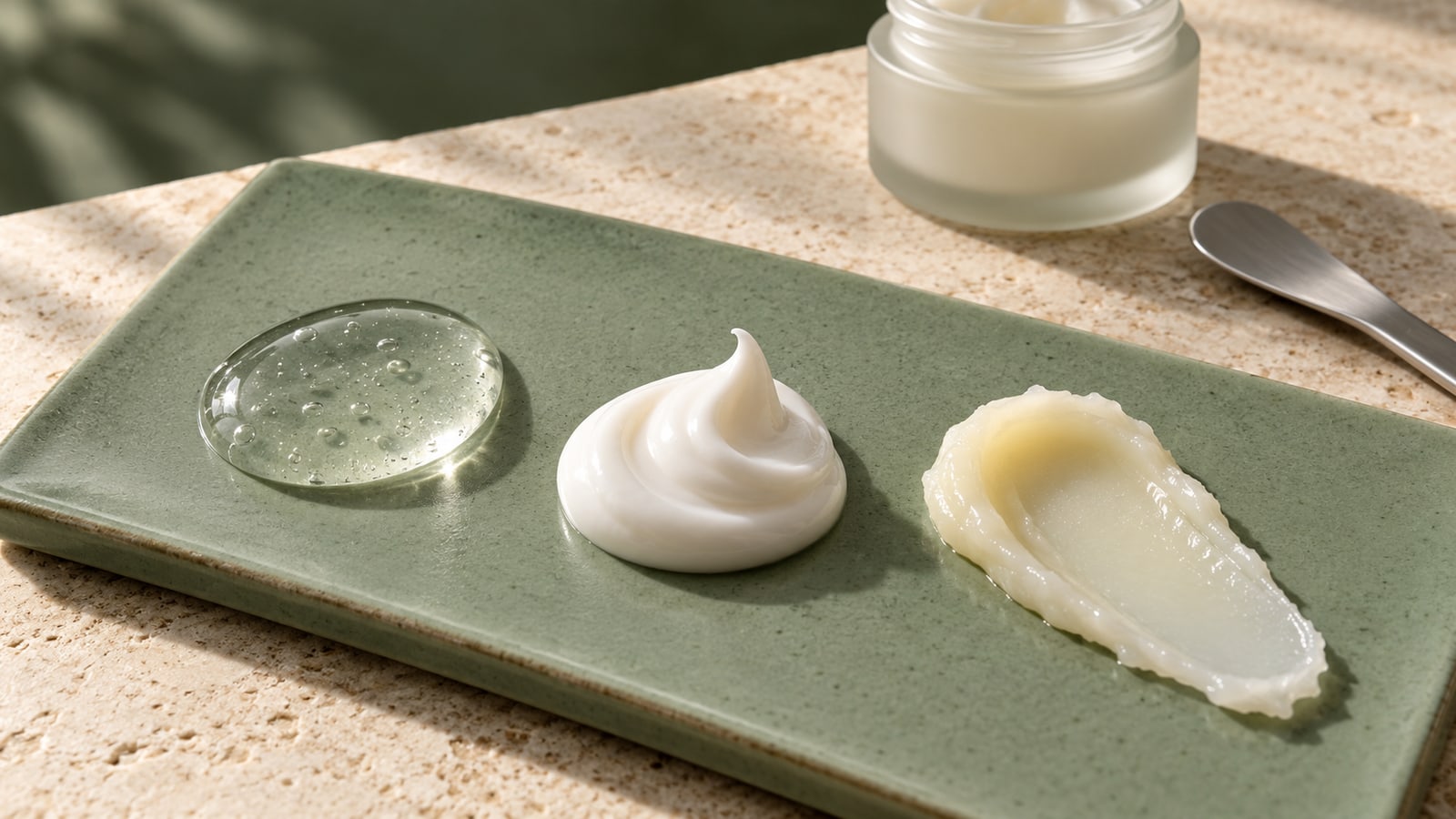
Humectants, Emollients and Occlusives: What a Moisturiser Actually Does
Understand the different jobs moisturiser ingredients perform and how to assess a finished product without buying unnecessary extra steps.
Niacinamide in Skincare: Uses, Evidence and Possible Irritation
Read niacinamide claims in context, understand what small trials studied and assess a finished formula without assuming stronger is better.