Reading an INCI List: What an Ingredient Label Can Tell You
Understand cosmetic ingredient names, ordering rules and label limits, with practical advice for checking known allergens and product claims.
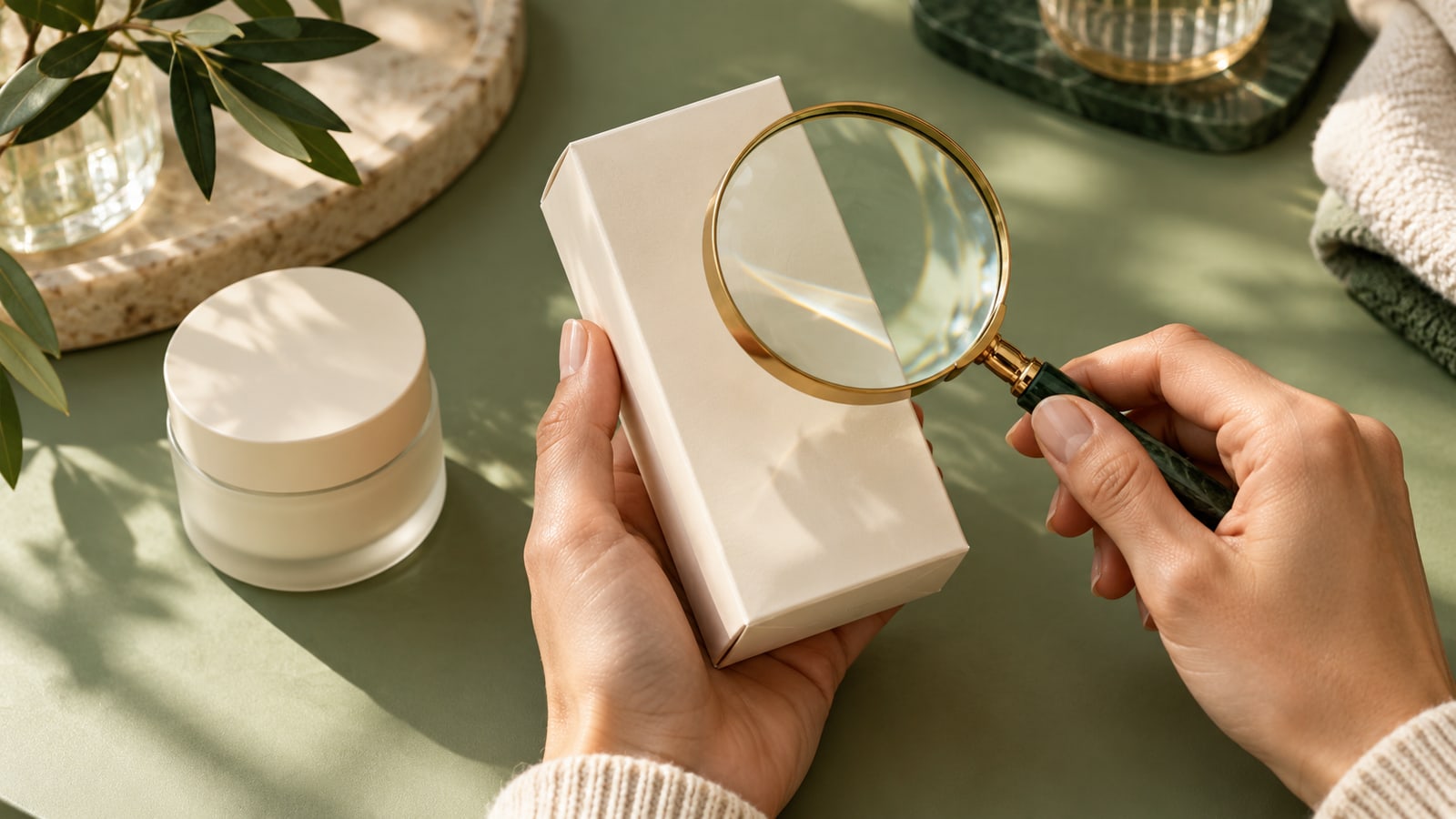
An ingredient list is useful information, but it is not a complete recipe or a prediction of how a product will behave on your skin. Learning a few naming and ordering conventions can help you compare products without turning every unfamiliar word into a warning.
This guide explains what an INCI list can tell you, what remains unknown and how to use it when checking a known allergy or discussing a reaction. The regulatory examples concern cosmetic products and should not be confused with medicine instructions.
Key takeaways
- INCI names provide a shared way to identify cosmetic ingredients.
- List order offers limited information about relative amounts, not exact percentages.
- Fragrance and colour conventions need context.
- A label cannot establish performance or individual tolerability by itself.
- Keep the current packaging when checking allergies or reporting a reaction.
On this page
- What INCI means
- Find the complete and current list
- Understand the ordering rule and its limits
- Read fragrance and colour terms in context
- Do not turn an ingredient list into a performance score
- Use allergy information precisely
- Read a label in four steps
- Be cautious with automatic ingredient ratings
- Keep the decision simple enough to use
- Common questions
- Sources and further reading
What INCI means
INCI stands for International Nomenclature for Cosmetic Ingredients. The Cosmetic, Toiletry and Perfumery Association explains that these names are used to make ingredient identification consistent across cosmetic labels.
The words may look technical because they are identifiers rather than marketing descriptions. A long name does not tell you that an ingredient is dangerous, just as a familiar botanical name does not guarantee that a product will suit you.
When checking a particular substance, use the name supplied by your clinician or the exact spelling on the label. Similar-looking words can identify different ingredients, as our guide to squalane and squalene illustrates.
Find the complete and current list
Government consumer guidance for Great Britain says cosmetic products must provide an ingredient list, which may appear on the outer packaging. Other required information includes precautions, product identification and details of the responsible person.
Keep the carton if it contains information missing from the container. A retailer’s photograph may show an older formula, so compare it with the product actually supplied and ask the brand about any discrepancy.
If a product has been reformulated, a list saved several years ago may no longer answer your question. Record the product name and batch details when contacting the manufacturer, particularly if the concern involves a reaction.
Understand the ordering rule and its limits
Official Great Britain guidance describes ingredients as listed in descending order by weight when added. Ingredients present below 1% may appear in any order after those at 1% or above, and colourants have additional listing conventions.
This means that position is not an exact concentration statement. You cannot reliably calculate a percentage from how many ingredients appear before a name, or identify a precise “1% line” by spotting a familiar preservative.
Two formulas with similar lists can still differ in amounts and manufacturing choices. If a percentage is important to a product claim, look for a clear statement about the finished product and ask what that figure describes.
| Clue | What it helps with | What it does not establish |
|---|---|---|
| An exact ingredient name | Identifying a listed substance | Whether the whole product will suit everyone |
| Position in the list | Some information about relative amounts | An exact percentage or complete recipe |
| Parfum or aroma | Recognising fragrance or flavour conventions | Every detail of the mixture |
| A short ingredient list | Fewer listed components to compare | Automatic superiority, safety or effectiveness |
Read fragrance and colour terms in context
CTPA explains that “parfum” indicates perfume and “aroma” indicates flavour. Decorative cosmetics sold in multiple shades may use “may contain” or a plus/minus symbol for the colourants used across the range.
Official guidance also requires certain fragrance components to be named individually when applicable labelling thresholds are exceeded. A fragrance discussion therefore involves more than looking for a single word.
If you have a diagnosed fragrance allergy, follow the specific avoidance information supplied by your clinician. Our guide to fragrance labels and sensitivity explains why marketing language and medical allergy advice are not interchangeable.
Do not turn an ingredient list into a performance score
A list does not show the finished product’s texture, pH, packaging performance or results in use. It also does not tell you whether an advertising claim was tested on the product or borrowed from research about one ingredient.
Ask what the product is intended to do and what evidence supports that claim. A cleanser and a leave-on cream may contain familiar ingredients for different reasons and be used under very different conditions.
Comparing only the first few names can also distract from practical questions: whether you can use the product as directed, whether it feels comfortable and whether it adds anything useful to your routine.
Use allergy information precisely
An ingredient list can help someone avoid a known allergen, but it cannot diagnose an allergy. If you have been given a list of substances to avoid, keep it available and ask for help with unfamiliar synonyms or unclear packaging.
If a new product causes a reaction, save the full list rather than selecting one ingredient to blame. Explain the timing, application site, other products used and whether you have had similar symptoms before.
Our guide to home spot tests and medical patch testing explains why a small home trial and a diagnostic allergy investigation are different processes.
Read a label in four steps
- Identify: Confirm the exact product and current list.
- Check: Look for any medically advised avoidance ingredients.
- Interpret: Use order and naming conventions within their limits.
- Decide: Consider purpose, evidence and practical suitability.
Be cautious with automatic ingredient ratings
A scanner or rating tool may flag a substance without explaining concentration, product type, exposure or the evidence behind the rating. Treat that output as a prompt to investigate a specific question, not as a personalised medical verdict.
Look for the source and the claim being made. “This ingredient can cause allergy in some people” differs from “this product will cause an allergy in you”. Similarly, a discussion of a raw material is not automatically an assessment of a finished cosmetic.
You do not need to research every ingredient before using an ordinary product. Focus on relevant needs, known allergies, clear instructions and any actual problem you are experiencing.
Keep the decision simple enough to use
When comparing two products, write down the reason for the comparison. You may be checking a known allergen, looking for a different texture or asking whether a featured ingredient is present at all.
If both products appear suitable, the label may not provide a definitive winner. Price, packaging and a routine you can maintain are legitimate considerations. A more complicated analysis is not always a more useful one.
If the packaging is unreadable or inconsistent, ask the brand for the information before buying. That is a concrete question with a concrete answer, unlike trying to infer an entire formulation from a promotional photograph.
Common questions
What does INCI stand for?
International Nomenclature for Cosmetic Ingredients.
Does list position reveal the exact percentage?
No. Ordering rules and exceptions prevent that calculation.
Is a long ingredient name a danger sign?
No. The name is an identifier, not a risk rating.
Does a short list guarantee a gentle product?
No. Suitability depends on the formulation and the person.
What does parfum mean?
It is the labelling term used for a perfume composition.
Can a list diagnose my allergy?
No. It can support avoidance after appropriate diagnosis and advice.
Should I keep the outer carton?
Yes, if it carries ingredients, precautions or identification details you may need.
Can an ingredient app replace professional advice?
No. Its rating may not account for your circumstances or the complete product.
Sources and further reading
Sources checked 22 October 2026. Great Britain guidance and CTPA naming information informed this consumer explanation; CTPA material was available through indexed text.
Keep exploring
A Simple Skincare Routine: The Essentials Before You Add More Products
A practical starting point for cleansing, moisturising and sun protection, with room for your skin’s needs and your budget.
How to Choose a Facial Cleanser for Your Skin’s Needs
Choose a facial cleanser by its purpose, instructions and comfort, with practical checks for labels, budget and your existing skincare.
Humectants, Emollients and Occlusives: What a Moisturiser Actually Does
Understand the different jobs moisturiser ingredients perform and how to assess a finished product without buying unnecessary extra steps.
Niacinamide in Skincare: Uses, Evidence and Possible Irritation
Read niacinamide claims in context, understand what small trials studied and assess a finished formula without assuming stronger is better.