Golf training can take many different paths, from cardiovascular workouts that boost stamina on the course to plyometric movements that increase swing speed, along with mobility and stretching drills that refine swing mechanics. With so many options available, it’s natural to wonder where to begin.
The Three Core Golf Fitness Fundamentals
According to Golf Digest Certified Fitness Trainer Justin Barr, effective golf training comes down to three essential elements. First, you must learn to intentionally separate upper- and lower-body movement. Second, you need to activate and forcefully contract the glute muscles. Third, you should use the ground as leverage to properly sequence the swing and generate explosive power.

Focusing on these three core principles—what Barr calls the “FUNdamentals”—puts you on a clear path toward developing a more efficient and powerful golf swing. These fundamentals are particularly helpful for beginner golfers as they start to grasp what a proper swing truly requires.

Training for Automatic, Effortless Movement
As with any sport, the ultimate goal is to train until the movement becomes automatic and instinctive. Barr, who works with golfers in Jupiter, Florida, emphasizes building patterns that require minimal conscious effort. With that approach in mind, he recommends three specific exercises designed to improve swing sequencing and deliver a noticeable power boost.
These exercises can easily be added to an existing routine or used as the base of a new workout program. When performed in order and following Barr’s guidelines, the entire sequence should take just five to ten minutes.
Pancakes to Cupcakes
This exercise teaches your body to generate swing power through the glutes by training each side to work independently. Lie flat on the ground like a pancake, placing your hands beneath your glutes. Forcefully squeeze one side of your glute muscles and lift your pelvis quickly, forming the rounded top of a cupcake. Slowly lower your pelvis back down using the same glute.
Barr suggests visualizing the upward motion as switching on a bright LED light, then using a dimmer switch to gradually reduce the brightness on the way down. You should move from flat glutes to a strong, rounded muscular contraction. Perform five repetitions per side, with each rep lasting about six seconds—one second up and five seconds down.

Wall-Supported T-Spine Rotations
This movement trains your torso to rotate independently from the lower body, a critical skill for properly loading during the backswing. Stand close to a wall or similar support and cross your arms over your chest. Lift your left foot (or right foot for left-handed golfers) and place it against the wall.
Keep your lower body as still as possible while rotating your upper body as though you’re making a backswing. Perform this drill for two minutes, alternating which foot is supported and the direction of rotation, always rotating toward the planted leg. Complete five slow, controlled reps in each direction.
Load and Explode (Fast-Track Swing Feel)
This exercise helps you feel the loading and release of power from backswing to through-swing. Ideally, use a resistance band around the lead leg and a soft object under the lead foot to press into, though the movement can also be done without equipment.
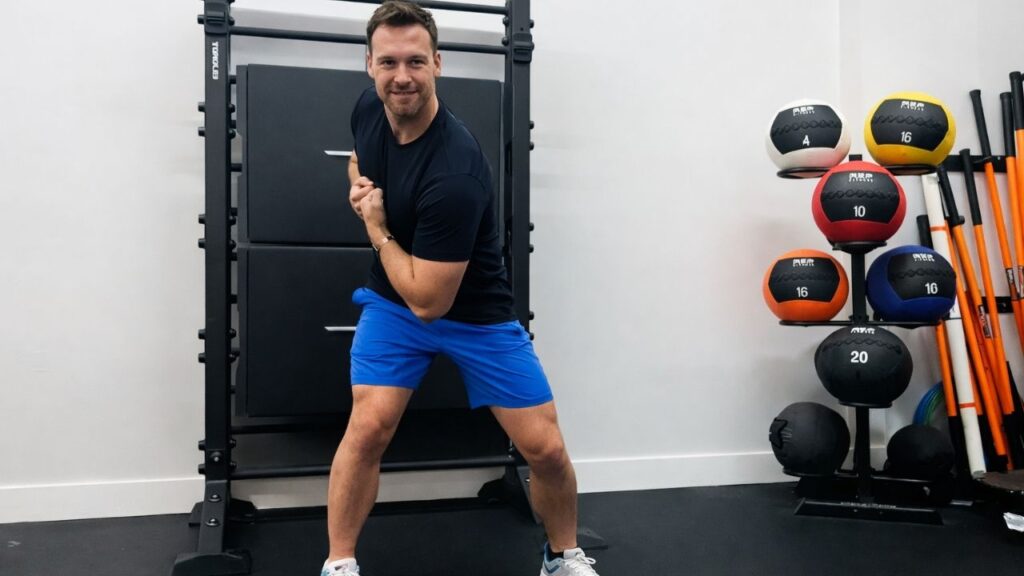
Barr refers to this drill as the “Clark Kent to Superman” transition. Start in your golf address position with your hands placed on your sternum, as if preparing to pull your shirt open. While pressing into the object under your lead foot, simulate a backswing, then transition into a through-swing.
Perform 10 repetitions in each direction, switching the band and foot placement. Hold the loaded backswing position for six seconds before explosively moving into the through-swing. Without a band, imagine rotating back with control, then firing powerfully in the opposite direction as if transforming into Superman, adding energy and intent to each repetition.