
The first time you really notice your hamstrings is usually when something goes wrong. It might happen when you bend down to tie your shoes and feel that sharp pull down the back of your legs. Or maybe during a run when your stride gets shorter and your legs feel stiff instead of loose and strong. Most people only think about their hamstrings when they feel tight or sore or close to injury. But these long powerful muscles control how we walk and sit & move every day. We just don’t realize how much we depend on them until we notice we’ve been demanding a lot from a body we rarely take care of.
The Silent Pull of the Hamstrings
Spend a day noticing the back of your legs and you will realize how much your hamstrings do. Walking upstairs lifting groceries from your car or bending down to grab something all depend on them. When your hamstrings work well the movement feels easy & natural. When they are tight every bend reminds you that tension exists in your muscles & not just in your thoughts. Modern life makes hamstrings tighter. Sitting at a desk for hours, driving long distances or relaxing on the couch all keep your hamstrings in a shortened position. They stay contracted like a rubber band that never stretches out. Eventually your body accepts this as normal and anything beyond that range feels uncomfortable or even painful in your lower back. People think of touching your toes as showing off but it actually shows that your body can move freely without struggle. Your hamstrings play a big role in that ability. Flexible hamstrings help your lower back, make walking smoother, let your hips move fully & affect how your knees feel. When hamstrings stay tight for too long your body tries to fix the problem in other areas. Your lower back gets compressed, your pelvis shifts and other muscles do work they were not designed to handle. Hamstrings are not like stiff cables but more like living tissue that responds to how you treat it. With regular gentle stretching they change and sometimes adapt faster than you expect. The important thing is to change your method. Instead of forcing flexibility with aggressive stretches think of it as having a conversation with your body. Each stretch is one part of that conversation and over time you build understanding and trust.

Listening to the Back of Your Legs
Before you start stretching take a moment to try something simple. Stand up straight with your feet under your hips. Roll down slowly one vertebra at a time and let your head hang down with your arms reaching toward the floor. Don’t force anything. Just pay attention to where your body naturally stops. Can your fingertips easily pass your knees or do your hamstrings stop you halfway down with that familiar tight feeling? Does your lower back seem to be doing all the work or can you feel the long muscle running from your sitting bones to the back of your knees starting to engage? This basic forward fold is like taking a reading of your body without any judgment involved. Hamstring flexibility isn’t just about the muscles themselves. Your nervous system also needs to feel safe when you move into deeper positions. Fast & forceful stretching like bouncing or pulling yourself down too hard triggers a warning signal in your body. Your muscles respond by contracting even more to protect you. That’s why the best hamstring stretches feel surprisingly easy and gentle. Your hamstrings don’t respond well to aggressive treatment. They need regular practice with slow movements and steady breathing. This method builds not just more length but also better control. You end up with flexibility that actually helps you when you’re running or lifting weights or dancing or even just bending down to grab something that rolled under the couch.

Foundations: How to Stretch Your Hamstrings Safely
Before you start with the specific stretches it is useful to know a few basic rules that will protect your hamstrings and make your routine last longer: Always warm up before stretching. Take a short walk or do some light cycling for a few minutes or walk up & down some stairs to get your blood flowing. Trying to stretch cold muscles is like attempting to bend frozen clay. Focus on breathing slowly & imagine releasing tension with each breath out. Every time you exhale let your body sink a tiny bit deeper into the stretch instead of pushing hard. Keep the stretch intensity mild to moderate. If you rate it from 1 to 10 you should aim for somewhere between 5 & 7. You want to feel a clear stretch but there should be no pain or burning sensation or sharp pulling behind your knee. Hold each position without bouncing. When you hold still for 20 to 40 seconds your nervous system has time to adjust properly. Bouncing makes your muscles tense up instead. Remember your injury history. If you have strained your hamstrings in the past then take it extra slow. Scar tissue needs patience and gentle treatment to heal properly. The table below gives you a quick overview of the stretches that follow. You can easily scroll back to check it while you practice on your phone.
| Stretch | Position | Hold Time | Best For |
|---|---|---|---|
| Seated Hamstring Fold | On floor or firm mat | 20–40 sec / leg | Everyday flexibility |
| Standing Front-of-Chair Stretch | Standing, leg on chair | 20–40 sec / leg | Office, travel, tight lower back |
| Supine Strap Stretch | On back with strap/towel | 20–60 sec / leg | Beginners, sensitive backs |
| Runner’s Lunge to Half-Split | On floor, lunge position | 20–40 sec / leg | Runners, active movers |
| Dynamic Leg Swings | Standing, holding support | 10–15 swings / leg | Warm-up before sport |
Stretch 1: The Seated Hamstring Fold
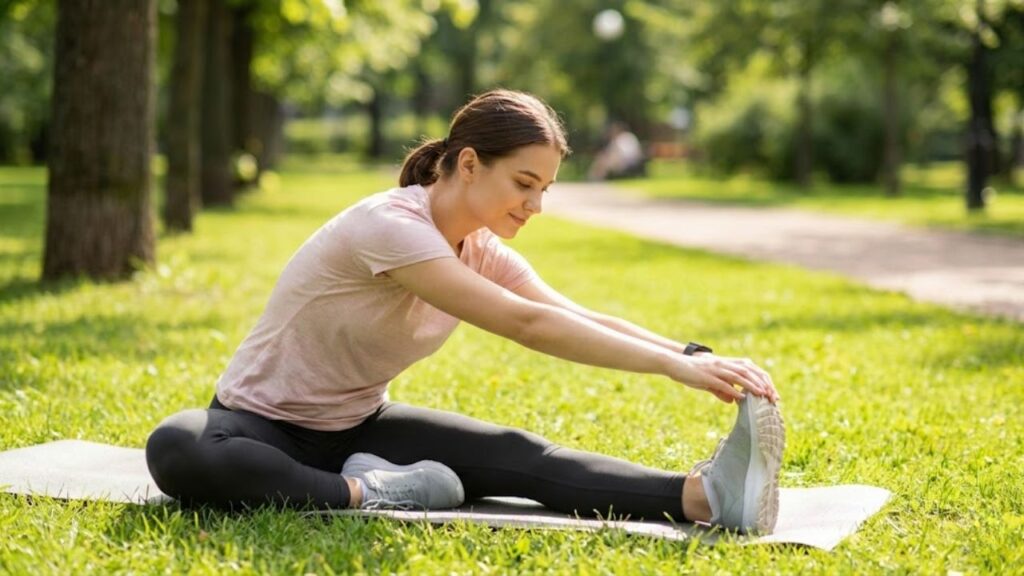
Picture yourself closing a book rather than rolling into a ball. That describes what a proper seated hamstring stretch should feel like. Sit on the floor and extend your right leg straight ahead while bending your left knee so the sole of your left foot touches your inner right thigh lightly. If your lower back curves and your tailbone tucks underneath you should put a folded blanket or towel under your sitting bones to create a slight forward tilt. Point your right foot upward so your toes face the ceiling. Put your hands on both sides of your thigh. Breathe in & imagine your spine getting longer as if a thread is pulling the top of your head upward gently. When you breathe out bend forward from your hips instead of your lower back. Your hands can stay on your thigh or shin because touching your toes is not what matters. What matters is getting a genuine and comfortable stretch along the back of your leg. The tightest spot might appear anywhere from just below your sitting bone to behind your knee. This entire area is your hamstring. Rather than forcing yourself to go lower you should stop at the first noticeable stretch & breathe calmly. Each time you breathe out allow your shoulders to relax away from your ears and release tension in your jaw. After 20 to 40 seconds sit back up slowly and then repeat with the other leg. Some days you might feel a strong stretch without bending forward much. This is perfectly fine. You are working with your body as it is right now and that is the only way genuine progress happens. With regular practice these small improvements add up similar to earning interest from a steady investment.
Stretch 2: The Standing “Anywhere” Hamstring Stretch
One of the best hamstring stretches is simple & you can do it almost anywhere like at work or in a park. You just need something stable around knee height such as a sturdy chair. Stand up straight & face your chair. Put your right heel on the seat with your leg mostly straight but keep a slight bend in the knee so it does not lock. Pull your right foot back so your toes point toward you because this activates the entire back of your leg. Keep your hips pointing forward like car headlights aimed straight. Take a breath in to make your spine longer and imagine a straight line from your tailbone to the back of your neck. When you breathe out lean forward a little from your hips. The movement is small and you might only tilt slightly before you feel the stretch down the back of your raised leg. Put your hands lightly on your lifted thigh or hold onto a wall or table for balance. You are not trying to touch your chest to your leg but rather letting your hamstrings lengthen while the rest of your body stays relaxed and straight. Hold this position for 20 to 40 seconds & then lower your leg & switch to the other side. If you feel pulling behind the knee more than in the middle of your thigh then bend your knee a bit more or reduce how far you lean forward. This stretch works well for breaking up long periods of sitting because it is so easy to adjust. Doing one or two rounds per leg during an afternoon break can remind your body that it is meant to move instead of staying folded in a chair all day.
Stretch 3: Lying Down with Support (Supine Strap Stretch)
Sometimes the best way to stretch is to lie down and let the floor support your weight so your muscles can finally relax. The supine strap stretch does exactly that. Lie on your back on a mat or carpet with your knees bent and feet flat on the floor. Loop a yoga strap or long scarf or towel around the arch of your right foot. Slowly extend your right leg toward the ceiling while holding the ends of the strap in both hands. Your left leg can stay bent with the foot on the floor or you can extend it long along the ground for a deeper stretch if your lower back feels comfortable. Gently straighten your right leg until you feel a clear but not overwhelming stretch in the back of your thigh. Let your shoulders stay heavy and your neck relaxed and your face soft. The strap is not there to yank the leg higher but to let your arms rest. Think of using it like reins on a very gentle patient horse. As you breathe you might notice your leg slowly drifting a little closer toward your torso. If the stretch moves behind the knee then back off the angle slightly or add a tiny bend to the knee. Hold for 20 to 60 seconds depending on comfort and then slowly release & switch sides. This position is especially kind to people with tight lower backs because the floor provides solid support. It is an excellent way to wind down at the end of the day or as part of a restorative evening routine that reminds your body that rest and release are skills too.
Stretch 4: From Lunge to Half-Split – For the Movers
If you regularly run or hike or do strength training your hamstrings are both tight and strong. They need stretches that recognize their strength and work with it in a dynamic way. Moving from a runner’s lunge into a half-split stretch does this while also engaging your hips and calves. Begin in a low lunge position with your right foot forward between your hands and your left knee resting on the ground. Your right knee should be directly above your ankle and your left toes can point either way behind you. Take a moment here to notice the stretch at the front of your left hip. Then as you breathe out start shifting your hips backward and straighten your right leg while walking your hands back so they are positioned on either side of your extended leg. Keep your right heel planted with your toes pointing up toward the ceiling. Your hips should be positioned roughly above your left knee which remains on the ground. Bend forward from your hips and maintain a long spine instead of letting your chest collapse forward. You should feel a strong stretch along your hamstring & possibly into your calf as well. Hold this position for 20 to 40 seconds and use your breathing as a guide. When you breathe in focus on lengthening & when you breathe out relax into the stretch. To exit the position shift forward into your lunge again. Do this flowing movement several times & move slowly between the lunge and the hamstring stretch before switching to the other side. This continuous back & forth movement lengthens your hamstrings and helps your hips and legs work together better which leads to smoother and more efficient movement when you are running or hiking.
Stretch 5: Dynamic Swings to Prepare for Action
Before you run or work out hard your hamstrings need to wake up with movement rather than long static stretches. Leg swings are a safe way to prepare your muscles as long as you keep them controlled and stay within a comfortable range. Stand sideways next to a wall or fence and rest your hand on it lightly for balance. Keep your left foot planted firmly on the ground and let your right leg hang loose. Start swinging your right leg forward and backward in a slow pendulum motion. Begin with small swings that feel natural and don’t cause any pain or sharp pulling sensations. As your body gets warmer you can gradually increase the size of the swing while staying below the point where your hamstrings feel tight or uncomfortable. The movement should feel loose as if your leg is a rope hanging from your hip. Do 10 to 15 swings and then switch to the other side. These dynamic stretches don’t replace longer flexibility sessions but they serve an important purpose. They prepare your legs for the movements you’re about to do & train your muscles and nervous system to coordinate smoothly. This reduces the chance of sudden strains when you sprint or jump or change direction quickly.

Weaving Stretching into the Fabric of Your Days
The real progress in hamstring flexibility comes from regular practice rather than single intense sessions. It develops through simple stretches you repeat so often they become automatic. Two or three stretches held for a few breaths each can fit into small breaks throughout your day like when you make coffee or finish a run or wait between meetings or get ready for bed. Here is a basic routine to follow:
Most days: Do one seated hamstring fold for each leg plus one standing chair stretch for each leg.
Before exercise: Complete 10 to 15 dynamic leg swings for each leg.
Evening or rest days: Try the supine strap stretch & then do the lunge to half split flow on both sides.
After a few weeks you should notice small improvements. Tying your shoes becomes easier. Your walking stride gets a bit longer. Your lower back hurts less after sitting for long periods. These small changes show that your hamstrings are adapting to the increased range of motion. You are building more than just flexibility.
You are creating a connection between yourself and your body and between effort & comfort and between routine and purpose. Each time you stop to stretch you send your body a message that you want to use it for many years & you are committed to maintaining it. Over time this commitment delivers benefits that extend well beyond basic flexibility goals.