The first time you notice your balance has changed it usually happens without warning. It’s a subtle shift. You might reach for something on a high shelf and feel your body sway in an unfamiliar way. You might step down from a curb and find your foot pausing instead of moving forward smoothly. Or you might realize that standing on one leg to put on pants has become difficult when it used to be automatic. Between your daily routines and the passing years your sense of balance began to fade without you really noticing.
The Subtle Art of Staying Upright
Balance is one of those invisible skills like breathing or blinking that we rarely think about until something goes wrong. Yet it works constantly in the background with tiny muscles in your feet adjusting to uneven ground and joints communicating with your brain while your inner ear tracks how your body tilts and sways. This silent coordination changes as we get older. Muscle fibers become thinner. Reaction times get slower. Vision becomes less sharp around the edges. The inner ear that acts as our natural level and compass can lose some of its precision. None of this means you are fragile but it does mean your body is being more direct about what it needs. Sometimes it simply asks for a little help. The encouraging part is that balance can be improved at any age. Your nervous system remains adaptable and your muscles still respond to training. You don’t need expensive gym equipment or complex routines to help your body regain its steadiness. What you need is simple & regular practice along with some curiosity and a willingness to feel a bit unsteady on purpose. Imagine yourself standing with bare feet on the floor and your toes spreading out like roots while you breathe calmly as your body learns to organize itself with more grace. The exercises that follow are not flashy or impressive. Nobody will share videos of you doing them online. But they could make the difference between catching yourself when you stumble and falling to the ground. They might help you move through your daily life with quiet and renewed confidence as you take each careful step.

Awakening Your Feet: The Foundation of Balance
Balance starts in a place you might not expect. It does not begin with your mind or your goals. It begins at the point where your body connects with the ground beneath you. Your feet are remarkably sensitive structures filled with countless nerves that send constant signals to your brain. These signals tell you about the texture of the surface under you and how your weight shifts from side to side. They also inform you about whether the ground is flat or uneven. Modern life has changed how our feet work. When you wear rigid shoes that limit natural movement your feet lose some of their ability to sense the world. When you spend most of your day sitting at a desk or on a couch those important signals become weaker. The connection between your feet and your brain starts to fade. Your nervous system receives less information about balance and position. Over time this makes it harder for your body to maintain stability & respond quickly to changes in your environment.
Drill 1: The Four Corners Stand
Take off your shoes and stand with your feet positioned about hip-width apart. Allow your toes to spread naturally. You can do this on kitchen tiles or a wood floor or even a rug. Think of each foot as having four corners: the ball beneath your big toe & the ball beneath your little toe along with the two sides of your heel. Gently shift your weight until all four corners press equally into the ground. You might notice at first that you favor the outer edges or lean more into your toes than your heels. Let your weight move slowly in a circle by going forward and then right and then back and then left. This creates a slow wobbly ring around those four corners. After that you can gradually bring your weight back to the center. Hold this balanced position for 20 to 30 seconds at a time & rest when you need to. Breathe as though the air is reaching down to your feet. This exercise is not just about muscles but about reestablishing the connection between your feet & your brain.
Drill 2: Heel-to-Toe Rocking
Stay barefoot and stand next to a counter or solid chair that you can hold for balance. Position your feet directly under your hips. Gently shift your weight forward until your heels start to lift slightly off the ground. Then shift back until your toes relax & your heels press down firmly. Take your time with each movement. Keep the motion small & controlled because the goal is not to lose balance but to discover how far you can lean in each direction. Notice how your ankles make tiny adjustments and how the muscles in your calves & shins work together. Pay attention to when your toes grip the floor and when they let go. Do this rocking motion 10 to 15 times slowly. Think of this exercise as warming up a skill that has not been used much lately. These basic exercises work better than you might expect. When your feet can properly feel the floor beneath them your entire body moves more efficiently & with less strain.
Standing Still, Feeling Everything
Stillness is never truly still. When you stand completely motionless your body makes countless small adjustments similar to a boat floating on calm water. Getting better at balance begins with recognizing this subtle activity.
Drill 3: Single-Leg Support (With Training Wheels)
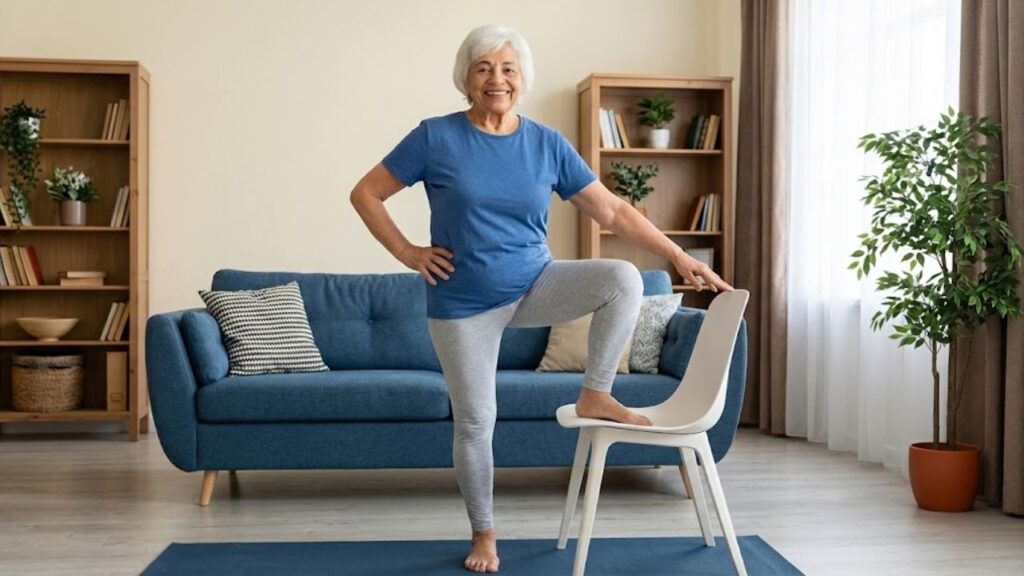
Find a counter, table, or the back of a sturdy chair. Stand tall with your feet hip-width apart. Lightly rest one hand on your support. Shift your weight onto your left foot, then slowly lift your right foot a few inches off the ground, bending the knee so the toes hover. You are not aiming to balance like a flamingo; the goal is to feel supported, alert, and steady.
Spread the toes of your standing foot. Gently engage your belly as if bracing for a soft poke. Fix your gaze on something still in front of you—a mark on the wall or a cupboard handle works well. Begin with 10–15 seconds on each leg. If your ankle trembles or your muscles quiver, that is a good sign; it means your body is learning.
As this becomes easier, reduce how much you rely on your support. Progress may look like using only fingertip contact, then hovering your hand just above the surface, ready if needed. Over time, you may find yourself standing for 30 seconds on each leg, breathing calmly, your body making subtle, steady adjustments.
Drill 4: The Soft-Standing Challenge
Once single-leg standing feels familiar, add a gentle variation by softening your knees. Many people lock their knees without noticing, turning their legs into rigid pillars that respond poorly to change. Instead, stand on both feet with your knees slightly bent, as if you were about to sit down and then changed your mind.
Now lift one foot just an inch or two off the floor. Notice how the softly bent knee on your standing leg allows more flexibility. It may feel less elegant than a straight-legged pose, but it is more honest and far safer when life surprises you with a slippery surface or sudden turn.
Practice 3–5 rounds on each side, holding for 10–20 seconds at a time. Let your arms float out for balance if needed. This small bend is often the difference between being rigid and being ready.
Walking the Line: Turning Everyday Steps into Training
Walking is a series of controlled falls, one foot catching you again and again. As we age, that control can feel less reliable. Instead of moving automatically from task to task, you can turn a few steps into intentional practice, creating a quiet training ground woven into daily life.
Drill 5: Tightrope Walk (With Safety Nets)
Find a clear stretch of floor such as a hallway, living room path, or kitchen walkway. If you feel unsteady, stay near a wall or countertop so you can reach out if needed.
Imagine a thin line painted on the floor. Place the heel of one foot directly in front of the toes of the other, as if walking on that imaginary line. Take one slow step, then another. Let your arms extend slightly to the sides. Keep your gaze forward rather than down; this trains your vision and inner ear to work together.
Take 8–10 steps along your invisible line, then walk back normally. If it feels too wobbly, widen your steps. Over time, you may notice your feet aligning more naturally and your steps growing more confident.
Drill 6: Backward and Sideways Steps
Life rarely moves in perfect straight lines. You step back from the fridge, move sideways past a table, or dodge someone moving quickly. Training these directions prepares your balance for real-world demands.

For sideways stepping, stand tall with your feet together. Lightly hold a wall or counter if needed. Step your right foot to the side, then bring your left foot to meet it. Take 8–10 steps in one direction, then return, noticing how your hips and thighs work differently.
For backward stepping, keep the movement small. Step back gently with your right foot, then bring your left foot to meet it. Keep your gaze forward, occasionally checking your path. Focus on control rather than speed.
Upper Body, Inner Calm: Using Breath and Posture
Balance involves more than feet and legs. The way you hold your spine, ribs, and head plays a major role. When shoulders round or the head juts forward, your center of gravity shifts, making it harder to stay upright.
Drill 7: The Tall String
Stand or sit with your feet flat on the floor. Imagine a gentle string lifting you from the crown of your head. Let your chin soften slightly as your head rises upward.
Roll your shoulders up, back, and down, keeping them relaxed. Feel your ribcage stacking over your pelvis. Take three slow breaths, inhaling through your nose as your ribs expand, and exhaling through your mouth as if fogging a window.
Holding this tall posture while breathing trains your postural muscles without strain and helps calm your nervous system, which supports steadier balance.
Drill 8: Head Turns with a Steady Body
Stand with your feet hip-width apart, lightly holding a chair or counter if needed. Fix your gaze on a steady point. Slowly turn your head to look over your right shoulder, return to center, then look over your left shoulder.
Complete 5–8 turns each way. This movement helps your eyes and inner ear coordinate with your body, preparing you for everyday situations like crossing a street or scanning a room.
Weaving Practice into a Real Life
Balance practice does not require a special schedule or gym clothes. It can blend into ordinary moments throughout your day.
Stand on one leg while brushing your teeth, keeping your hand near the sink. Hold a single-leg stance at the counter while waiting for the kettle. Rock heel to toe while washing dishes. Use pauses in your day to notice where your weight is and whether you can breathe without tension.
Consistency matters more than intensity. Think of these moments as small daily deposits into your balance savings account.
Quick Reference Summary
| Drill | What It Trains | How Often |
|---|---|---|
| Four Corners Stand | Foot awareness, weight distribution | Daily, 30–60 seconds |
| Heel-to-Toe Rocking | Ankle control, forward–back balance | 3–4 times per week, 10–15 rocks |
| Single-Leg Support | One-leg stability, core engagement | Daily, 10–30 seconds each leg |
| Tightrope Walk | Gait control, coordination | 3–5 passes, 3 times per week |
| Tall String + Head Turns | Posture, eye–inner ear coordination | Daily, 1–2 minutes |
Listening to Your Edges, Honoring Your Pace
There is a difference between helpful challenge and unnecessary risk. Gentle wobbling is fine; sharp pain is not. Effort is welcome; panic is not. The aim is to invite your body to remember its abilities, not to force it.
If you have a history of falls, dizziness, joint replacements, or complex medical conditions, consider reviewing these drills with a healthcare professional or physical therapist. Using support or progressing slowly is a sign of wisdom, not weakness.
Progress often arrives quietly. One day you may realize you have been standing on one leg longer than before, breathing steadily, feeling grounded. Age moves forward, but you are not only a passenger. Each mindful step is a vote for your future mobility, stability, and independence.