
The first time you use a truly sharp knife to cut through a ripe tomato it can catch you off guard. The blade glides through without any effort and meets the cutting board with a soft sound. You suddenly understand what a properly sharpened knife should feel like. There is no crushing or sawing back & forth. Just one smooth cut that goes straight through. When this happens your whole approach to cooking starts to change. Food prep becomes easier and you feel more capable in the kitchen. All of this comes from one basic skill that many people overlook: learning how to sharpen a kitchen knife until it has a razor-sharp edge.
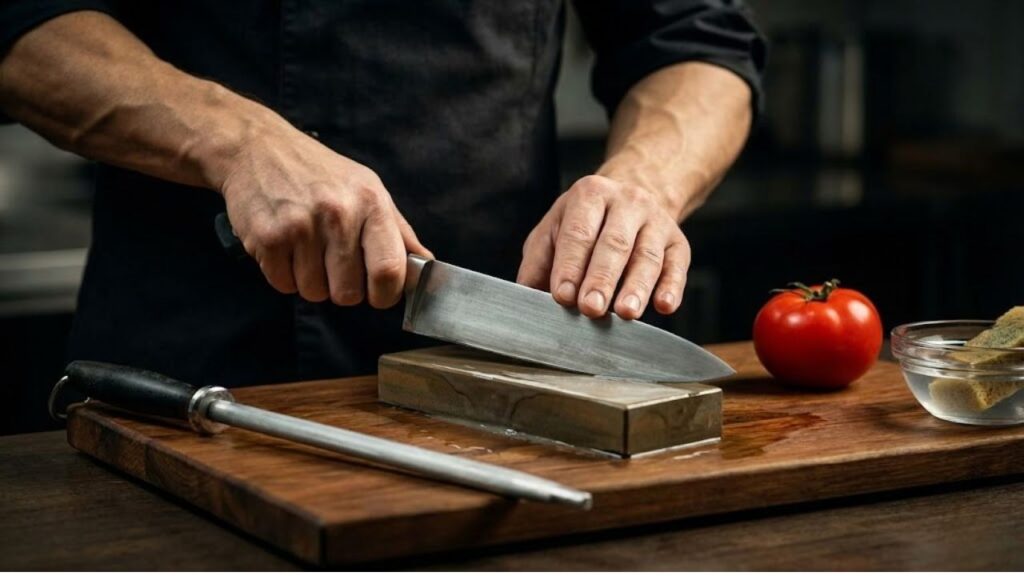
The Quiet Reality of Living With Dull Knives
Most home cooks tolerate dull knives far longer than they should. It shows in hesitant cutting motions, crushed herbs, uneven slices, and the way a blade slips instead of biting into food. A dull knife doesn’t just slow you down—it increases risk. When the edge won’t cooperate, you push harder, twist your wrist, and apply force where precision should exist. That’s when accidents happen. Ironically, a sharper knife is often the safer one, because it works with less pressure and more control.

The reassuring truth is that most kitchen knives aren’t ruined—they’re simply ignored. Over time, regular chopping, improper storage, and dishwashers slowly degrade the edge. With basic tools like a whetstone, a honing steel, and a little patience, most decent knives can be restored to a clean, confident sharpness that glides through food effortlessly.

Why Sharpening Is About Attention, Not Strength
Knife sharpening isn’t a test of power. It’s a slow, intentional process that reshapes steel at a microscopic level. The experience itself can be grounding: the steady rhythm, the soft scrape of metal on stone, the way your hands gradually learn what your eyes cannot measure. You don’t need machines or a workshop—just a flat surface, a stone, some water, and focus. When done well, sharpening becomes less of a chore and more of a mindful routine.
Understanding Honing Versus Sharpening
Many people confuse honing with sharpening. That metal rod in your knife block doesn’t remove much steel at all. Instead, it realigns the edge, which naturally bends and folds during everyday use. Honing straightens that edge, restoring performance temporarily. Sharpening, by contrast, removes metal to form a new edge. A whetstone grinds away fatigued steel and creates a fresh bevel, delivering true sharpness. Both tools matter, but they serve different purposes.
Choosing the Right Whetstone for Home Use
Whetstones are categorized by grit. Coarse stones repair damage and reshape very dull edges. Medium grits handle most routine sharpening, while fine stones refine and polish the edge. For most home kitchens, a combination stone—such as 1000/3000 or 1000/6000—is more than sufficient. Paired with a honing steel, this setup covers nearly all edge-maintenance needs without unnecessary complexity.
| Tool Name | Main Function | Recommended Usage Frequency |
|---|---|---|
| Honing Rod / Steel | Straightens the blade edge and preserves sharpness during regular use | Use after a few cooking sessions or whenever cutting feels less smooth |
| Coarse Whetstone (400–800 Grit) | Fixes damaged edges and restores knives that are extremely dull | Rarely required; only when the blade has chips or severe wear |
| Medium Whetstone (1000–2000 Grit) | Sharpens the knife and forms a fresh, effective cutting edge | Use every few weeks or months based on cooking frequency |
| Fine Whetstone (3000+ Grit) | Smooths and polishes the edge for precise, razor-like sharpness | Apply after medium sharpening, whenever extra refinement is needed |
Preparing a Stable and Focused Sharpening Space
Sharpening works best when your environment feels deliberate. Clear your counter and place a damp towel underneath the stone to prevent slipping. If using a water stone, soak it until air bubbles stop rising. Keep water nearby to maintain a thin slurry on the stone’s surface. This mixture of water, stone particles, and steel debris improves cutting efficiency and polish. A stable setup builds confidence and consistency.
Finding the Correct Sharpening Angle Naturally
Perfect angles aren’t required. Most Western knives sharpen well at around 15–20 degrees per side. You can estimate this by raising the knife spine slightly off the stone—roughly the height of two or three stacked coins. With repetition, your hands will remember this position instinctively. Consistency matters far more than precision.
Executing Smooth, Controlled Sharpening Strokes
Begin with the heel of the blade and guide it across the stone so the entire edge makes contact. Use long, even strokes and maintain your chosen angle. Listen to the sound—it should be steady and smooth. After several passes, switch sides. Whether you alternate strokes or complete one side at a time, controlled motion and steady pressure are the keys to progress.

Recognizing Progress Through the Burr
A burr is a thin ridge of metal that forms when you’ve sharpened fully through the edge. Carefully feel for it on the opposite side of the blade, always moving your finger perpendicular to the edge. Once the burr appears along the entire length, switch sides and repeat. Lighter, alternating strokes help reduce and remove the burr, refining the edge rather than folding it.
Refining and Honing the Finished Edge
After stone work, the knife is sharp, but honing perfects it. Use light alternating passes on the stone or gently draw the edge through soft wood to remove lingering burrs. Then use the honing steel with calm, deliberate strokes. This aligns the edge and smooths microscopic imperfections. Speed isn’t required—precision is.
Testing Sharpness Safely and Effectively
A sharp knife will slice paper cleanly and pierce a tomato’s skin without pressure. Another simple test is resting the blade gently on your thumbnail—it should catch rather than slide. Always test carefully and never run your fingers along the edge. Respect is the foundation of safety.
Maintaining Sharpness Through Daily Habits
Sharp knives stay sharp longer when treated well. Avoid dishwashers, use wooden or plastic boards, and hone lightly before regular use. Honing doesn’t replace sharpening, but it extends the life of the edge. These small habits preserve your work and improve your cooking experience.
Sharpening as a Skill and a Mindset
Knife sharpening isn’t about perfection—it’s about awareness. Over time, your hands learn pressure, angle, and rhythm. You begin to notice when an edge needs attention and respond confidently. Beyond practicality, sharpening offers quiet satisfaction: caring for your tools, understanding their behavior, and engaging fully in a simple, focused task.
In the end, a sharp knife is more than a kitchen tool. It’s an invitation—to cook with ease, to move with intention, and to bring presence into everyday work. With practice, sharpening becomes not just maintenance, but a meaningful part of the craft itself.