
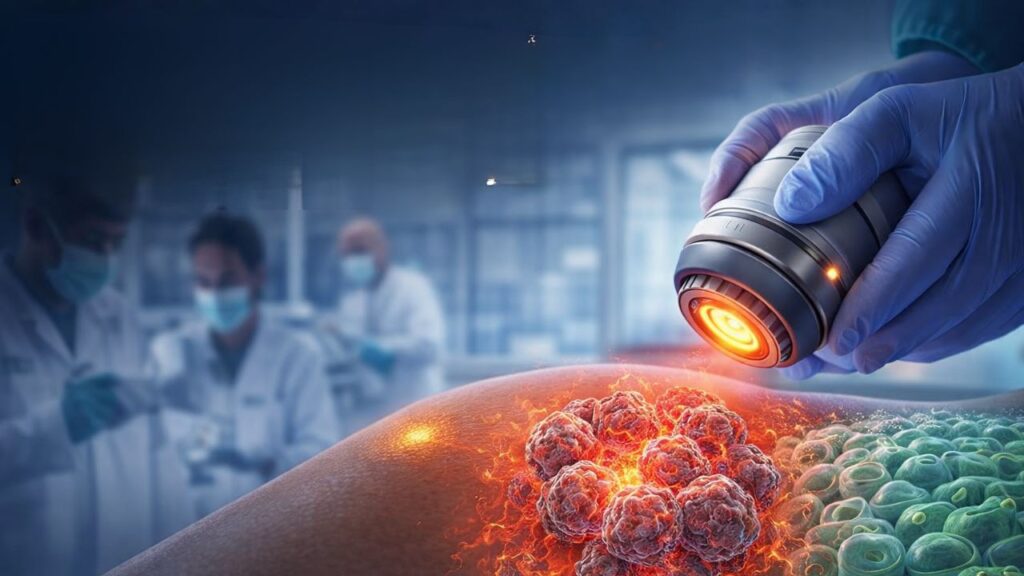
Patients, oncologists, and researchers are all familiar with a difficult trade-off. Treatments that successfully shrink tumours often leave a lasting impact on daily life, ranging from chronic fatigue to permanent organ damage. Emerging research now points toward a different strategy: using light-activated tin particles to selectively heat and destroy cancer cells, while leaving surrounding healthy tissue largely unharmed.
Why Current Cancer Therapies Still Take a Heavy Toll
Modern cancer care continues to rely on three main pillars: surgery, chemotherapy, and radiotherapy. Each has saved countless lives, but none act only on the tumour itself. Chemotherapy drugs circulate throughout the body, radiotherapy can damage nearby organs, and even successful surgery may result in pain, nerve injury, or lasting physical changes. This reality has driven scientists to seek treatments that focus more narrowly on cancer cells and reduce collateral damage to healthy tissue.
Tin Nanoparticles and Light: A New Experimental Approach
A research collaboration between the University of Texas at Austin and the University of Porto has introduced a novel tactic. Their work uses microscopic tin-based particles combined with a simple near-infrared LED light source to heat tumours from within. In laboratory experiments, this method eliminated up to 92% of skin cancer cells in just 30 minutes, while causing minimal harm to nearby healthy cells.

How Tin-Based Photothermal Therapy Works
Published in ACS Nano, the technique belongs to a broader category known as photothermal therapy. The principle is simple: introduce a light-responsive material into cancer cells, expose it to a specific wavelength, and allow it to convert light into localized heat that destroys malignant tissue. Instead of gold or carbon materials used in other studies, this team employed ultrafine tin oxide nanoflakes (SnOx), each only a few billionths of a metre wide.
Localized Heating That Spares Healthy Cells
These SnOx nanoparticles absorb near-infrared light with high efficiency and convert it into heat in a tightly confined area. Cancer cells containing the particles are damaged by the temperature rise, while nearby regions without significant particle presence remain relatively cool. This targeted heating is key to reducing unintended injury to healthy tissue.
Replacing Lasers With Simple LED Technology
Traditional photothermal systems often depend on high-power lasers that are costly, complex, and capable of overheating healthy tissue. The new study stands out by using low-cost, compact near-infrared LEDs instead. This shift moves the concept closer to a practical medical device rather than a specialized laboratory setup.
Why Near-Infrared LEDs Make a Difference
Near-infrared light penetrates human tissue more effectively than visible light while remaining gentle enough for repeated exposure. According to the researchers, an LED-based design could significantly reduce costs, simplify equipment, and expand access to hospitals without advanced laser infrastructure.
What the Early Laboratory Results Show
In controlled cell-culture experiments, the team tested the method on human skin cancer and colorectal cancer cells. After applying SnOx particles, the samples were exposed to near-infrared LED light for 30 minutes.
- Skin cancer cells: Up to 92% cell death after one session, with minimal damage to nearby healthy cells.
- Colorectal cancer cells: Around 50% elimination under the same conditions, indicating that effectiveness varies by cancer type.
The particles also maintained their heating performance through multiple cycles, an important factor for treatments that would require repeated sessions. These findings are based on in vitro experiments, meaning they were conducted in lab dishes rather than in animals or humans.
Why Protecting Healthy Tissue Matters So Much
Cancer treatment is not only about extending life but also about preserving quality of life. A method that damages cancer cells while largely sparing healthy ones could help clinicians better balance benefit and risk. Targeted heating may complement existing therapies, potentially allowing lower drug doses and fewer long-term side effects.
Potential Benefits for Localized Tumours
For superficial cancers, such as many skin tumours or residual cells near surgical scars, a controllable local heat source is especially appealing. Instead of broad radiation fields or prolonged chemotherapy, a short, focused LED session could target remaining cancer cells more precisely.

Envisioning Future Devices and Practical Use
Project leader Artur Pinto has described a future where this technology moves beyond specialized hospital settings. Because LEDs are small, efficient, and portable, they could form the basis of compact treatment devices used closer to patients.
From Hospital Rooms to Bedside Tools
In an ideal scenario, patients recovering from skin cancer surgery might use a handheld or patch-based device placed over the treated area. The device would deliver timed near-infrared light sessions to activate tin particles injected around tumour margins.
- Post-surgical care to reduce the risk of local recurrence.
- Outpatient clinics offering brief maintenance sessions.
- Home-based use for stable patients under remote supervision.
How This Method Could Fit With Existing Treatments
New cancer therapies rarely replace established methods immediately. More often, they become part of combination strategies. Photothermal therapy could follow the same path.
- After surgery: Target microscopic cancer cells left at tumour margins.
- Alongside chemotherapy: Allow lower drug doses while maintaining control.
- With immunotherapy: Destroy resistant tumour pockets and release antigens.
- Palliative care: Reduce painful superficial lesions with fewer systemic effects.
The UT Austin Portugal programme has already allocated further funding to adapt this approach to other cancers, including breast cancer, where near-infrared light may still reach vulnerable tumour areas.
Key Questions That Still Need Answers
Despite promising results, many uncertainties remain. Laboratory dishes do not replicate the complexity of the human body, where blood flow, immune responses, and tissue movement all influence treatment outcomes.
- Delivery: Ensuring particles reach tumours without affecting sensitive organs.
- Dosing: Defining safe and effective light exposure levels.
- Clearance: Understanding how the body removes tin-based nanoparticles.
- Long-term safety: Ruling out delayed toxicity or inflammation.
The Scientific Importance of Tin and Near-Infrared Light
Near-infrared wavelengths occupy a biological sweet spot, where tissue absorbs less energy, allowing deeper penetration and controlled heating. Tin oxide offers additional advantages: it is relatively inexpensive, widely used in industry, and its optical properties can be adjusted by altering particle size and structure.
What Patients and Families Should Watch Next
Experimental breakthroughs often appear years before becoming real treatment options. Meaningful progress will depend on:
- Independent replication by other research teams.
- Animal studies confirming both effectiveness and organ safety.
- Early-phase clinical trials in human patients.
- Transparent reporting of side effects and limitations.
For now, LED-driven tin nanoparticle therapy remains an early but promising approach within the broader field of photothermal cancer treatment. Its focus on precision, lower cost, and protection of healthy tissue may signal a future shift toward therapies that are not only effective, but also kinder to the body.