
Some days move fast, and before you realize it, a workout slips away. The good news is there’s one effective move you can fit in anytime, anywhere. All you need is a wall, a ball, and your own bodyweight.
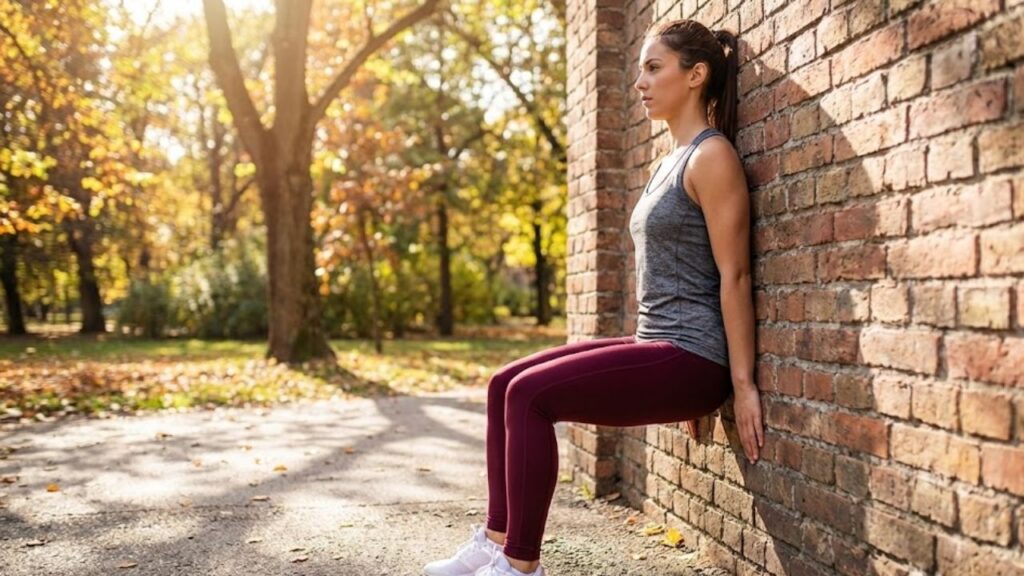
This exercise helps build lower-body strength while improving mobility. Because you also need to control the ball during the movement, it encourages better thoracic mobility in the upper body and improves overall muscle stability. Focus on engaging your core and keeping your torso upright throughout the movement.

If you have access to a Pilates ball or Swiss ball, use that. If not, a tennis ball or similar-sized ball will still get the job done.

A Go-To Exercise When Time Is Tight
The wall-ball prisoner squat is a full-body movement that strengthens your legs, glutes, and core. With your hands placed behind your head, your body has to work harder to stay upright as you squat. This naturally engages more of the upper body as you pull your shoulder blades back, helping to open the chest. If your mobility is limited, you may find this more challenging than a regular bodyweight squat.
Adding the ball behind your back increases the challenge. You’ll need to stabilize the ball against the wall, allowing it to roll smoothly along your spine as you lower and stand. This sharpens the mind-muscle connection, as you stay aware of the ball’s position throughout the movement.
Why This Exercise Is Effective
The wall-ball prisoner squat works because it targets several key areas at once: functional strength, core engagement, and mobility and stability. As a bonus, the rolling motion of the ball provides a gentle massage to the spine and surrounding muscles, which can feel especially relieving after long hours spent sitting.
Spending just a few minutes on this movement each day helps increase blood flow and keep muscles active, supporting healthier joints and improved posture. It’s also a compound exercise, meaning it works multiple muscles and joints together, making it efficient for coordination and balance.
How to Perform the Wall-Ball Prisoner Squat
When starting out, you may prefer to keep your arms by your sides. Once you feel more confident and stable, you can progress to placing your hands behind your head.
Stand with your back against a wall and your feet about hip- to shoulder-width apart.
Place the ball at your lower back, just above your glutes.
Gently position your hands behind your head and draw your shoulder blades together to open your chest.
Keeping your chest upright and core engaged, bend your knees and lower into a squat, lightly pressing your back into the ball as it rolls upward.

Your feet should stay slightly in front of you, with your back parallel to the wall so the movement stays vertical.
Maintain control of the ball so it doesn’t slip. Pause briefly at the bottom of the squat.
Push through your feet to stand, guiding the ball back down as you rise.
You can perform this exercise for a few minutes continuously, rest, and repeat for 2–3 rounds. Another option is to complete 6–12 repetitions for 3–4 sets. Once the movement feels comfortable, try lifting your heels and staying on the balls of your feet to further engage your calves and quadriceps. This progression can be practiced using a high-heeled squat.
It may seem simple, but this single daily exercise is a powerful way to develop strength, stability, and mobility with minimal equipment.
About the Coach
Sam Hopes is a Level 3 qualified personal trainer, Level 2 Reiki practitioner, and fitness editor at Tom’s Guide. She is currently completing her Yoga for Athletes training.
With experience writing for leading fitness brands and publications including Live Science, Fit&Well, Coach, and T3, Sam brings a broad perspective to health and training content.
She has coached at studios such as F45 and Virgin Active and now focuses on outdoor bootcamps, bodyweight training, calisthenics, kettlebells, and mobility-focused classes. Sam believes that true strength comes from a holistic approach to training the body.
She has also competed in mixed doubles Hyrox events in London and the Netherlands, completing her first doubles race in 1:11.