
The first thing that greets you isn’t the furniture or the lighting—it’s the feeling in the air. Calm, soft, almost cushiony, as if the room itself is slowing its breath. There’s a hint of eucalyptus, a soft brightness from citrus, and something green and grounding that lingers without demanding attention. Before you even sit down, your shoulders loosen. That’s the unseen power of a spa: scent slips past logic and speaks directly to your nervous system, quietly assuring you, “You’re safe here.” Imagine walking into your home every evening and feeling that same gentle exhale—no harsh sprays, no artificial sweetness, just a natural fragrance that feels like rest.
The Hidden Language Behind Spa Scents
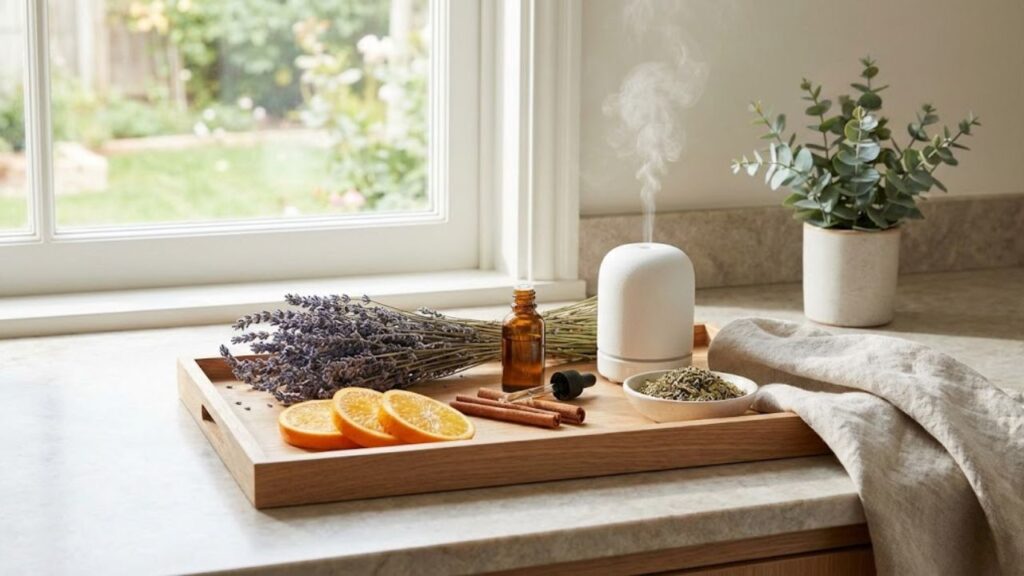
In a real spa, scent is never an afterthought. It is the environment. Every aroma is chosen to shape emotion, not just cover the air. Bright citrus signals freshness and clarity, even on heavy days. Lavender carries a softness that feels protective. Eucalyptus and mint sharpen awareness while still wrapping the body in ease. These scents work together like a silent conversation between plants and memory, guiding the body toward balance.

You can bring this atmosphere home without relying on synthetic plug-ins or overpowering sprays. In fact, removing artificial fragrances often makes the space feel calmer instantly. Natural scents behave differently—they don’t announce themselves from the doorway. They reveal themselves slowly, unfolding as you move through the room. Warm light hits wood and releases a subtle aroma. Steam rises from a shower and lifts herbal notes into the air. An open window lets evening air mingle with whatever’s gently diffusing nearby.

Think of your home as a living environment, and scent as the climate you shape. You’re not hiding smells—you’re designing a mood. And you don’t need expert training to do it. A few simple choices, curiosity, and a preference for plant-based aromas are enough to turn ordinary rooms into places of restoration.

Preparing the Space: Clean Air Comes First
A spa never carries the memory of old meals, damp fabrics, or stale corners. That’s because the foundation of good scent is cleanliness, not fragrance. Before adding anything beautiful to the air, the space itself has to breathe freely. Clearing out lingering odors creates room for subtle, natural aromas to actually work. Only then can your home begin to smell less like a place you manage—and more like a place you recover.