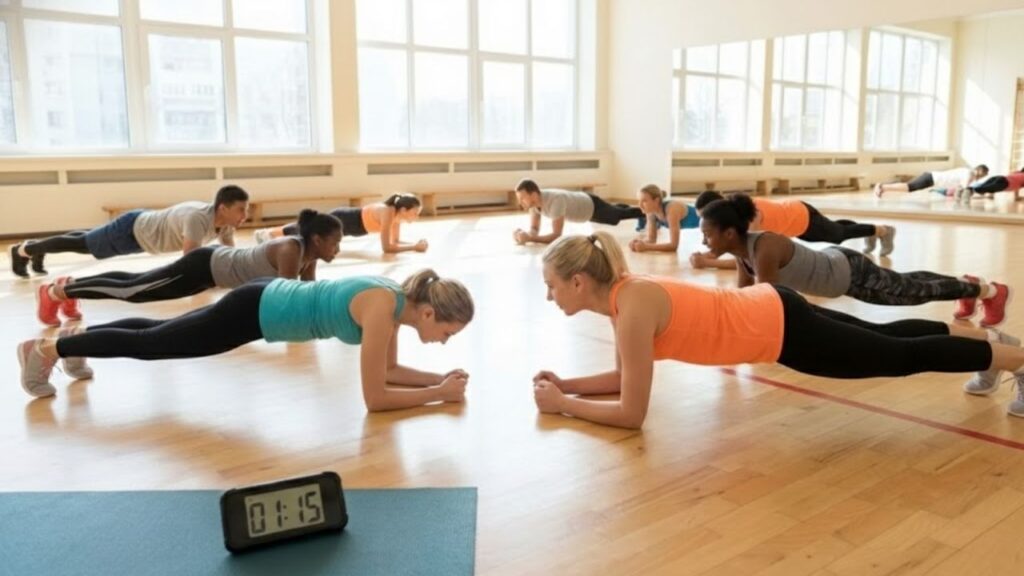
The floor presses cool against your forearms. Your toes grip the mat, legs engaged, and breathing settles into a steady rhythm. Between the tension in your core and the focus in your mind, a question arises: “How long should I hold this plank?” Ten seconds? Thirty? Two minutes that feel endless? Planks aren’t one-size-fits-all. They are a dynamic interplay between your body and gravity, evolving as you age. What feels strong at 18 can become challenging at 48 or demand extra care at 68. Across all ages, your core remains the foundation—supporting your spine, protecting your back, and allowing fluid movement. Determining the ideal plank duration starts with understanding your body as it is today.
Plank Hold Timing: How It Works
The Silent Strength Within
Unlike noisy workouts with pounding feet or clashing weights, planks arrive quietly. Your body forms one long line: shoulders stacked over elbows or wrists, heels reaching back, head floating naturally. From the outside, it looks effortless. Inside, however, a subtle storm activates. Deep stabilizers engage: the transverse abdominis tightens like a supportive belt, the multifidus protects the spine, the diaphragm links breath to effort, and the pelvic floor provides steady support from below. These muscles thrive on calm, precise effort repeated consistently.
 Best No-Weights Full-Body Workout: Personal Trainer Shares the Routine They Recommend Most
For this reason, quality matters more than duration. A tense, collapsing one-minute plank offers less benefit and higher risk than a clean twenty-second hold performed with strong alignment and control. Time is important, but it should end when your form begins to falter, not after pushing through discomfort.

The Truth About Long Planks
Fitness culture often glorifies extremes: two-minute holds, five-minute challenges, viral clips of shaking bodies clinging on by willpower. The reality is quieter: beyond a certain point, holding a plank longer builds tolerance for discomfort more than meaningful strength. Research and expert coaching agree—short, precise holds repeated regularly are more effective for core strength and spinal health than occasional marathon efforts.
This doesn’t mean long planks are harmful, only that the benefits diminish while the risk of fatigue-related misalignment rises. Over time, the question shifts from “How long can I endure?” to “How well can I support my body now?”
Age, Gravity, and the Plank Equation
As we age, the body’s response changes. Recovery slows, tissues stiffen, and balance demands more focus. A plank once effortless may now require intention—and that reflects biology, not weakness. Rather than a single rule, it’s helpful to follow flexible ranges based on your form and capability.
Suggested Plank Hold Times by Age
- Teens (13–19): 20–40 seconds, 2–4 sets, 2–4 days/week
- 20s–30s: 30–60 seconds, 2–4 sets, 3–5 days/week
- 40s: 20–45 seconds, 2–4 sets, 3–4 days/week
- 50s: 15–40 seconds, 2–3 sets, 2–4 days/week
- 60s–70s+: 10–30 seconds, 2–3 sets, 2–4 days/week
These ranges are guideposts, not rules. What matters most is the quality of each second you hold.
 Makeup Artists Recommend These Brightening Concealers for Instantly Refreshed Radiant Skin
Your 20s and 30s: Strength Without Limits
In this age range, recovery is fast, tissues resilient, and strength comes naturally. Thirty to sixty seconds is often ideal. The main risk is subtle breakdowns: hips dipping, shoulders creeping, or lower back warnings. Dividing effort into several shorter, controlled holds is more beneficial than one long, punishing attempt.
Your 40s: Strength With Awareness
By your 40s, your body communicates more clearly: old injuries, stiffness, or tightness appear faster. Most productive holds now range from 20 to 45 seconds, repeated a few times. Some days may allow longer holds, while other days stopping sooner is wiser. The focus shifts to sustainability and supporting posture over time.
Your 50s, 60s, and Beyond: Resilient, Not Reckless
Later decades require rethinking strength. Muscle mass may decline, balance may shift, and recovery may lengthen—but planks remain valuable. Short holds of 10–30 seconds with excellent alignment can be very effective. Modified versions like knee or incline planks are intelligent adaptations. Each well-supported second preserves posture, stability, and confidence in movement.
Recognizing When to Stop
Your body signals when a plank becomes risky: lower back sag, shoulder tension, breath-holding, or facial strain. Stopping at the first sign of form loss isn’t quitting—it’s smart training. This approach teaches your nervous system efficiency and prevents collapse over time.
Making Planks a Daily Practice
Planks don’t need to be dramatic. They can be sprinkled throughout the day: a short hold before coffee, another after work, one before bed. Over time, these small, consistent efforts build meaningful strength. The goal isn’t a record—it’s standing taller, moving confidently, and supporting your body in daily life. Hold as long as form feels honest. Rest. Repeat. That’s where lasting core strength lives.