
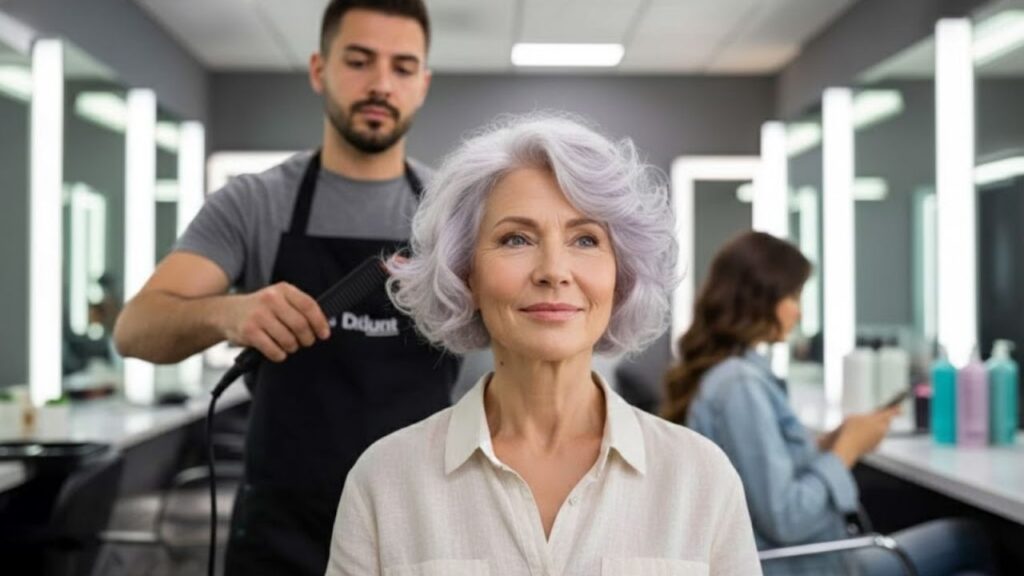
The woman sitting in the salon chair carried a familiar expression — a mix of anticipation and restrained fear. At sixty-two, silver roots visible, she pressed her lips together as the stylist lifted hair weighed down by years of home coloring and hesitant trims. Around her, younger women scrolled on their phones, their hair sleek and polished. She watched them briefly in the mirror, then returned to her own reflection, almost startled.
“I don’t want to look younger,” she said, hesitating. “Well… maybe I do. Just not absurd.”

The stylist smiled, already outlining an invisible frame along her jaw. Scissors caught the light. Blow-dryers murmured nearby. The atmosphere shifted — subtle, but unmistakable, like the start of a quiet act of defiance.

When the first section dropped minutes later, heads turned. Because this is the haircut that makes professionals murmur: this is the most youthful look after 60.
The most youthful haircut after 60 isn’t what you expect
Ask a few women over 60 what a “young” hairstyle looks like, and many will picture long, flowing hair. It’s an image borrowed from old shampoo commercials. Yet behind the scenes, many hairstylists agree on something else entirely.
Again and again, they point to a modern, softly textured bob — sometimes grazing the chin, sometimes resting near the collarbone. It isn’t sharp or rigid. It moves, frames the face gently, and avoids that helmet-like finish.
This cut doesn’t shout effort. Instead, it quietly lifts everything — the jawline, cheekbones, even posture. That’s why professionals often call it the most youthful haircut after 60, no matter your wrinkles, weight, or clothing style.
Why stylists keep recommending the modern bob
A London stylist once described a client, 68, who had kept the same below-shoulder layers since the 1980s. Her hair had thinned and lost its shape, yet she clung to the length because she believed long hair meant youth.
They settled on a compromise: a relaxed, jaw-length bob with soft texture and a side part. It didn’t look dramatic — just lighter, cleaner, more defined.
When she returned weeks later, she was puzzled. Colleagues asked if she’d done something to her face. Her granddaughter said she looked like she did in “old photos.” People noticed the change without identifying the haircut. And that is exactly what a well-executed bob after 60 is meant to do.
Why this haircut works so well after 60
As we age, hair density often decreases, particularly around the temples and parting. Long, heavy lengths pull that thinning hair downward, making the face appear tired.
A modern bob shortens visual lines and redirects attention toward the eyes and cheekbones instead of the ends. Subtle layering or a gentle undercut at the nape adds lift without relying on stiff products.
With soft face-framing pieces or a light fringe, forehead lines blur and jaw angles soften — no procedures required. The effect is understated but powerful: more freshness, more presence, more life.
How to ask for the youthful bob — and actually get it
The result isn’t about simply requesting a bob. It’s about tailoring it to your hair texture and daily routine. Skip vague terms like “trendy” or “chic.” Bring a few photos of women close to your age whose hair you genuinely admire.
Be clear about length — at the jaw, just below the chin, or brushing the collarbone. Ask for softness and movement, not a blunt, schoolgirl finish. And be honest about how much time you want to spend styling each morning.
The most youthful bob after 60 isn’t identical for everyone. It’s the one that fits your life without constant struggle.
The fear behind going shorter
Many women quietly admit that cutting hair shorter after 60 feels like giving in. There’s a fear that a bob signals the beginning of the “old lady haircut.” That fear keeps tired lengths hanging on far too long.
If your stomach tightens when the scissors appear, it doesn’t mean you’re vain — it means you’re human. Take it gradually. Reduce the length over a few appointments. Adjust, observe, refine.
A stylist’s truth about youth and hair
Hair at this stage carries emotional weight — stories of change, loss, renewal, and growth. In that setting, a bob is more than a style. It’s often a quiet declaration.
Making the transition easier
- Shorten the length gradually toward the jaw or collarbone
- Add subtle layers for movement, not rigid volume
- Lighten color slightly, avoiding flat, heavy tones
- Shift the part just off-center for a softer effect
- Test a light fringe before committing fully
Living with your new haircut every day
Gently towel-dry, apply a small amount of lightweight product to the mid-lengths and ends, and rough-dry with your fingers. Use a round brush only at the front to open the face. Five to eight minutes is enough.
The secret lies in controlled imperfection. Slightly undone ends feel fresher than rigid styling. Movement suggests energy, not effort.
Common mistakes to avoid
Many women fall into two traps. One is trying to recreate the salon blow-dry every day and feeling defeated. The other is letting the cut grow into an undefined in-between stage that drags the face down again.
Think of the bob as a living shape. Small tweaks matter more than big changes. A quick bend with a brush, a single pass of a flat iron, or a touch of root spray can revive it in seconds.
The mindset shift stylists notice most
As one Italian stylist put it, “The real glow-up happens when a woman stops apologizing for her age and starts choosing hair that matches her energy.”
A haircut that respects age and bends the rules
This modern bob sits comfortably in that space. You aren’t trying to look 40. You’re choosing a shape that brightens your expression, works with grey instead of fighting it, and fits your real routine.
Key points to remember
- Ideal length: Between jaw and collarbone with soft edges
- Texture: Light layering and gentle movement for freshness
- Maintenance: Trims every 6–8 weeks with 5–10 minutes of styling
