
The sharp silver line at her roots, louder than her lipstick, her blouse, even her voice, stares back at her in the mirror. She scrolls on her phone, half-dressed and already late, when a headline flashes across the screen: “New injection erases grey hair in 30 days.”
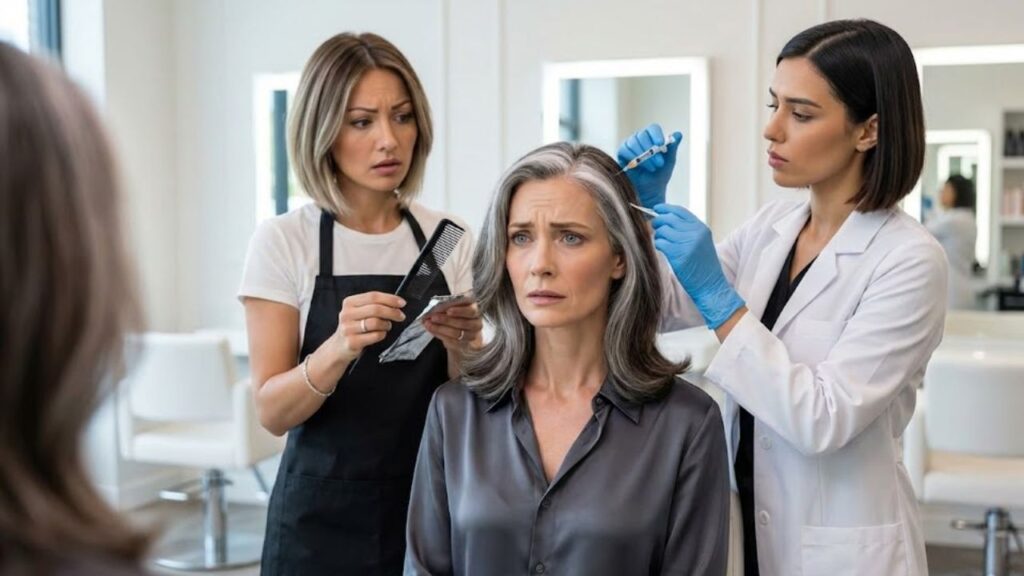
On TikTok, a woman half her age parts her hair to show her scalp, then cuts to the “after” clip: no grey, no regrowth, no visible filter. In the comments, some ask “Where?” and “How much?” Others warn “This is dangerous,” adding skull emojis. Somewhere between the excitement and the fear, real women are quietly booking appointments — or cancelling them.
 Daily Exercise Over 60: Personal Trainer Shares the 1 Move Worth Practicing Every Single Morning
This time, the promise doesn’t come with the smell of ammonia or stained towels. It comes with a needle.

The anti-grey shortcut sending shockwaves through salons
Ask any busy colourist in London, New York, or Paris, and you’ll hear the same story. Clients arrive clutching screenshots of so-called “melanin booster injections” that claim to turn grey hair back to its natural colour at the root. No monthly dye. No harsh regrowth line. Just a tiny injection marketed as the fastest way to look younger.
In the salon chair, emotions run high. Some clients compare it to Botox for the scalp. Others admit they’re exhausted from pretending they’re “fine” with going grey when it actually fills them with dread before meetings. The idea sounds almost magical, which is exactly why so many professionals feel uneasy.
One afternoon in a central London salon, a 49-year-old HR director unfolds a printed leaflet from a clinic in Turkey advertising “pigment restoration therapy.” The treatment claims to reactivate melanin cells using a blend of peptides and vitamins injected along the hairline. The cost is less than a year of regular salon colouring. The promise is up to 80% reduction in grey hair within three months.
The stylist hesitates. She’s seen similar offers online, often bundled with medical tourism packages — hair transplants, veneers, and now anti-grey injections. In some countries, these procedures are sold as cosmetic treatments. In others, they exist in a legal grey area, hovering between beauty and experimental medicine. Clients rarely ask about regulation. They focus on the before-and-after photos.
Dermatologists focus on what’s inside the syringe. Grey hair appears when melanocytes in the hair follicle slow down or disappear. Emerging research explores molecules that might protect or stimulate these cells. In theory, it sounds promising. In reality, many injectable formulas used in clinics lack robust, peer-reviewed evidence on long-term safety.
One doctor likens it to “flicking a switch on wiring you don’t fully understand.” Hairdressers have another fear: if a client reacts badly or experiences shedding, the salon often absorbs the blame. This trend sits right at the collision point of vanity, science, and money.
What these injections claim to do — and why many avoid them
Behind the dramatic marketing, the process is simple. A practitioner injects a liquid blend — usually peptides, antioxidants, amino acids, and sometimes unlicensed compounds — into the scalp along the parting and hairline. The claim is that these substances stimulate pigment cells, allowing new hair to grow in with its original colour.
Appointments typically last 20 to 40 minutes. Most clients are sold a course of sessions spaced weeks apart, followed by annual or biannual maintenance. Common side effects include tightness, itching, or tenderness. Some people notice darker regrowth in treated areas. Others see no change at all beyond small injection marks and a lighter bank balance. There is no guaranteed outcome.
Because of this uncertainty, many stylists are guiding clients toward less invasive alternatives. Grey blending with ultra-fine highlights doesn’t eliminate grey hair, but it softens contrast so regrowth is far less obvious. Subtle lowlights near the temples can reduce harsh white streaks without changing the overall shade.
Another growing technique uses semi-permanent root toners applied only at the parting. These fade within four to six weeks, avoiding the stark regrowth line of permanent dye. One Paris colourist calls it “Photoshop for the parting.” It requires precision, but it’s gentler on sensitive scalps than frequent colouring or injections.

Medical opinions remain divided. Some doctors believe tightly regulated pigment-restoring treatments may eventually help people who go grey unusually young. Others see the trend as cosmetic fear marketing wrapped in medical language. Meanwhile, hair professionals are left trying to protect both their clients’ confidence and their health.
Before letting anyone inject your scalp
If anti-grey injections are tempting, the most important step is also the least glamorous: a proper medical consultation. Not a sales chat in a polished clinic, but a real discussion with a qualified professional. Ask for a written list of every ingredient. Check whether those substances are approved in your country and for what use. Your scalp may be small, but your bloodstream is not.
A cautious dermatologist will likely ask about stress, nutrition, hormones, smoking habits, and family history. Some forms of premature greying are influenced by lifestyle factors. Blood tests may be suggested before any cosmetic procedure. It’s not common practice, but it’s safer than chasing a miracle solution blindly.
There’s also emotional groundwork to do. Pull your hair back in natural light and take a photo. Ask yourself what truly bothers you. Often it’s a narrow strip at the front or temples, not the entire head. A fringe, a softened parting, or a root-blur product can resolve most of the anxiety without medical intervention.
Many people who regret rushing into injections describe feeling subtly pressured — beautiful clinics, quick forms, and reassurance that they’re a “perfect candidate.” A simple rule applies: if you can’t walk away and think it over, walk away anyway. A trustworthy practitioner will welcome hesitation and second opinions.
Hairdressers are adapting too. They now ask about scalp treatments, topical medications, and recent procedures. A modern colourist often acts as both therapist and investigator, helping clients make informed choices rather than fear-driven ones.
| Key point | Details | Why it matters to readers |
|---|---|---|
| What’s actually in the injections | Most formulas mix peptides, vitamins, amino acids and antioxidants, sometimes alongside unlicensed actives that claim to “reactivate melanin”. Ingredients and dosages vary widely from clinic to clinic. | Knowing the cocktail helps you spot red flags, talk to a real doctor, and avoid paying premium prices for something that might be little more than expensive scalp mesotherapy. |
| How fast you might see a change | Hair grows roughly 1–1.5 cm per month. Any true pigment shift would show up only in new growth after several weeks, not overnight. Photos showing instant results usually rely on dye, lighting or filters. | This timeline keeps expectations realistic and makes it easier to question dramatic “30-day miracles” that don’t match basic biology. |
| Safer salon alternatives | Grey blending, lowlights around the face, root-shadow toners, and glosses can soften grey without fully covering it. Damage and scalp stress are lower than with frequent full-head dye. | These options offer a way to look fresher with far fewer risks than an untested injection trend, while still looking like yourself in the mirror. |
Where beauty and medicine now overlap
Grey hair is often the first visible reminder that time is moving faster than expected. This injection trend targets that vulnerability directly. It doesn’t just promise darker hair — it promises a quiet rewind of the relationship between age and identity.
Some people will refuse it entirely, embracing silver strands or managing them with low-tech colour techniques. Others will discreetly sign consent forms and hope they fall into the group that sees results. Between these extremes lies a growing middle ground: people who don’t worship youth, but aren’t ready to surrender their hairline without resistance.
The deeper tension isn’t only cosmetic. It plays out in workplaces, dating apps, and family photos, where grey hair still carries assumptions. The needle becomes a symbol in a much larger negotiation about visibility, ageing, and self-worth.
Before chasing a radical solution, mapping gentler options can be surprisingly effective:
- Root-blur sprays or powders for short-term coverage
- Gloss treatments to soften contrast and add shine
- Targeted grey blending at the front rather than full coverage
- Professionally guided supplements based on blood work
- A strategic haircut change that shifts focus from roots to movement
The conversation between doctors and hairdressers is only beginning. And for now, it’s happening right where everyone can see it — at the hairline.