
No oversized wooden table, no perfectly matched chairs, no decorative centrepiece waiting for a family roast that rarely happens. In a Copenhagen flat, a couple in their thirties eat on a low, wide structure that feels half sofa, half desk. Laptops are pushed aside, children crawl along the edges with crayons, and plates, mugs, and an open board game all share the same surface. Everything unfolds around this single piece.
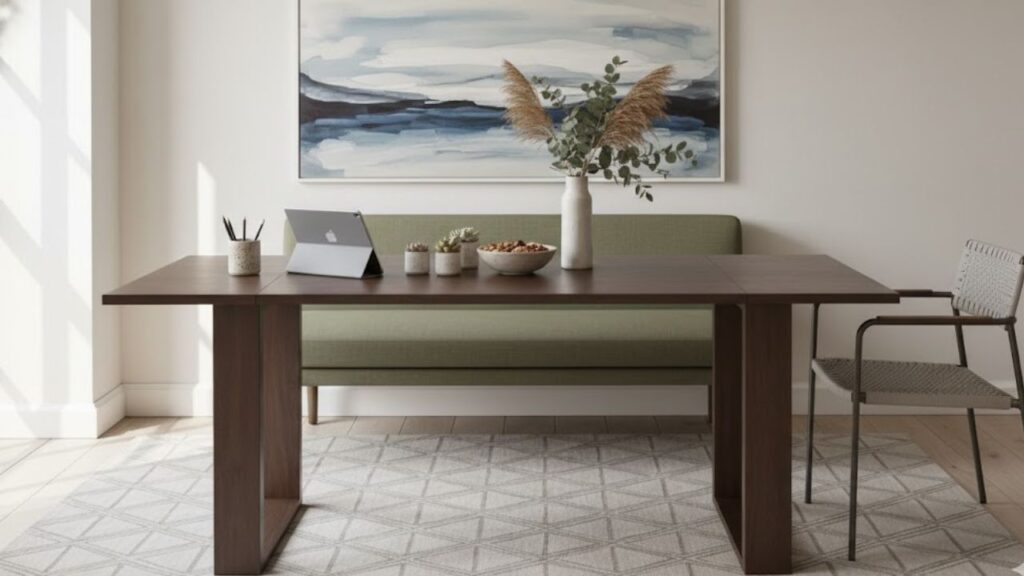
Later, in a compact Tokyo apartment hardly larger than a typical living room, the scene repeats itself. By the window sits a raised living platform with floor cushions and a slim ledge for food and drinks. People sit, stretch, lie back, work, eat, and scroll. The traditional dining table has vanished. What replaces it barely resembles furniture at all. It feels more like a quiet lifestyle shift, one that is steadily spreading across Europe and the United States.
 Goodbye Pressure Cookers: Safety Reviews Push Families Toward Smarter Automated Cooking Appliances
Farewell to the dining table: the rise of the living platform
Step into new apartments in Amsterdam, Berlin, or Oslo and the change is instantly visible. The once-dominant dining table has shrunk, been pushed against a wall, or disappeared entirely. Taking its place is a deep, generous living platform that serves as sofa, daybed, workspace, and casual dining area at the same time. Often positioned along a window or tucked into a corner, it feels like a built-in stage for daily life.

The mood of the room shifts with it. Instead of stiff chairs and fixed seating, people lounge, lean, and perch. Food arrives on trays and leaves just as easily. Children do homework at one end, emails get answered at the other, and visitors simply join the cushions. The message is subtle but bold: the heart of the home is no longer a table, but a shared surface where multiple activities coexist.
Designers trace this movement back to compact cities like Tokyo, Seoul, and Hong Kong, where space makes large dining tables impractical. There, tables dissolved into platforms, sofa-benches, and raised surfaces with storage below. Scandinavian studios brought the concept home, softening it with wood, wool, and light tones. From there, images spread rapidly through Instagram and Pinterest, carrying the idea with them.
Why flexible seating is replacing formal dining
Behind the visuals, the numbers tell a clear story. A 2023 survey by a major European furniture brand found that in small urban homes, dining tables are used for actual meals for less than 30 minutes a day. The rest of the time, they collect paperwork, laundry, and shopping bags. The same study showed that people value flexible seating far more than traditional dining setups when describing their ideal home.
The living platform resolves this mismatch. It still offers a place to gather, but without the rigid expectations of “sit properly, eat quickly, move on.” On a deeper level, it mirrors modern routines. Work spills into home life, screens follow people everywhere, and shared mealtimes are no longer perfectly aligned. The formal dining table, once a symbol of routine and order, can feel out of step with how people actually live.
This doesn’t signal a loss of connection. Instead, it reflects a desire for interaction that feels less staged. Platforms, modular benches, and oversized poufs encourage people to cluster, snack, talk, and drift in and out. They reflect a world where boundaries blur, capturing both the comfort and the complexity of contemporary home life.
From solid wood to shared surface: how platforms are built
At its core, the new centrepiece is simple. Picture a low base along a wall, around 30–45 cm high, deep enough to sit cross-legged or stretch out. On top sits a firm mattress, modular cushions, or custom-cut foam. Slim, movable tables—often on wheels or with folding legs—slide easily over knees when it’s time to eat or work. When the task ends, they roll away and the platform becomes a lounge again.
Many homes integrate storage into the base itself. Drawers replace bulky sideboards, hiding bedding, games, and laptops. In small Paris or London flats, the platform doubles as guest bed, streaming corner, and breakfast nook. Nothing about it immediately signals “dining area.” It appears as a cosy alcove or raised sofa, until a tray or adjustable table turns it into a place to eat.
Letting go of the table—and the rules that came with it
For many, the change begins with frustration. The dining table fills with folded clothes, school papers, and unopened parcels. Meals there happen only on special occasions. One Berlin couple sold their eight-seater oak table and used the money to build a corner platform beneath the window. They expected to miss formal dinners, but instead found friends sitting cross-legged around a large wooden tray, with no one stuck at the “head” of the table.

A traditional dining table quietly enforces roles and routines: where to sit, when a meal starts, when it ends. The living platform softens those rules. People arrive when ready, shift positions, or lie down after eating. For some, this feels chaotic. For others, it’s freeing. It aligns with real habits shaped by streaming dinners, late work calls, and children snacking at odd hours. On a platform, shared time grows naturally rather than being scheduled.
Switching to a platform without turning life upside down
Adopting this idea doesn’t require throwing out your table overnight. A safer approach is to scale it down. Replace a large table with a narrow console or a small foldable round table. Then create a test “micro-platform” in one corner using low benches, a thick rug, oversized floor cushions, and a couple of C-shaped side tables. Live with it for a few months and observe where people naturally gather.
Lighting plays a crucial role. Platforms feel most inviting with warm, layered light: a floor lamp, a low wall sconce, or subtle string lights along the edge. Movable tables should be within easy reach. If placing a plate feels inconvenient, old habits quickly return. A large tray becomes essential, acting as a temporary tabletop that appears for meals and disappears afterward.
No one lives like a design magazine every day. Some evenings happen on the sofa, others on the platform, others standing at the counter. The aim isn’t a flawless new ritual, but a flexible stage that supports several lives at once. Washable covers, darker fabrics, and a tolerance for mess help make the setup realistic. Like an old farmhouse table, it’s meant to be used, not protected.
Visitors may look around and ask where you eat. That’s when a small table slides into place and dinner seems to appear from nowhere. Letting go of the dining table can stir unexpected emotions, from guilt to relief. As one London architect put it, the table often represents how people think they should live, not how they actually do. Once it’s gone, the room finally matches real life.
- Set screen-light evenings so the platform doesn’t become a permanent workspace.
- Keep a nearby basket for chargers, notebooks, and remotes.
- Rotate cushions and throws with the seasons.
- Choose one durable low table that handles spills and heat easily.
What this shift reveals about modern living
Once you notice homes without dining tables, they appear everywhere—from design magazines to property listings and small-apartment tours online. The forms vary, from floor-level Japanese setups to Scandinavian platforms and modular sofas with clip-on tables. Beneath the variety lies the same idea: removing furniture that dictates behaviour and choosing pieces that adapt instead.
Some will always keep their scratched oak table, marked by homework and candle wax. Others will quietly add a platform by the window and see which space the family chooses. Over time, the language changes too. Instead of searching for room for a six-seater table, people start looking for space for a shared platform. That shift often says more than any mood board.
Homes evolve slowly, but they do evolve. Beds grow larger, kitchens merge with living rooms, televisions move to centre stage. Now the dining table, long a symbol of order and routine, is shrinking or stepping aside. In its place comes something softer and less defined, allowing eating, working, resting, and talking to happen in the same square metres. Love it or hate it, the idea raises a quiet question: if no rules were inherited, what would truly sit at the heart of your home?

- Ideal platform size: Around 180–220 cm long, 80–100 cm deep, and 30–45 cm high, enough for lounging or shared meals.
- Typical budget: DIY setups cost roughly €250–€600, while custom builds start near €1,200.
- Best materials: Stain-resistant fabrics, mid-tone colours, and high-density foam for comfort and durability.
- Movable surfaces: C-shaped tables, nesting tables, and large trays work better than one heavy coffee table.
