
Those long nights when you stare at the ceiling & flip your pillow over and over can exhaust anyone. When your mind refuses to settle down and your body feels restless it becomes easy to dread going to bed. In the next few minutes you will learn three practical methods based on evidence that help you fall asleep faster. You will also discover some evening habits that gently guide your brain and body toward rest. One of these simple tools might help you fall asleep before you even notice it happening. The first method involves controlling your breathing pattern. When you breathe slowly and deeply your nervous system receives a signal that it is safe to relax. Try breathing in for four counts & then breathing out for six counts.
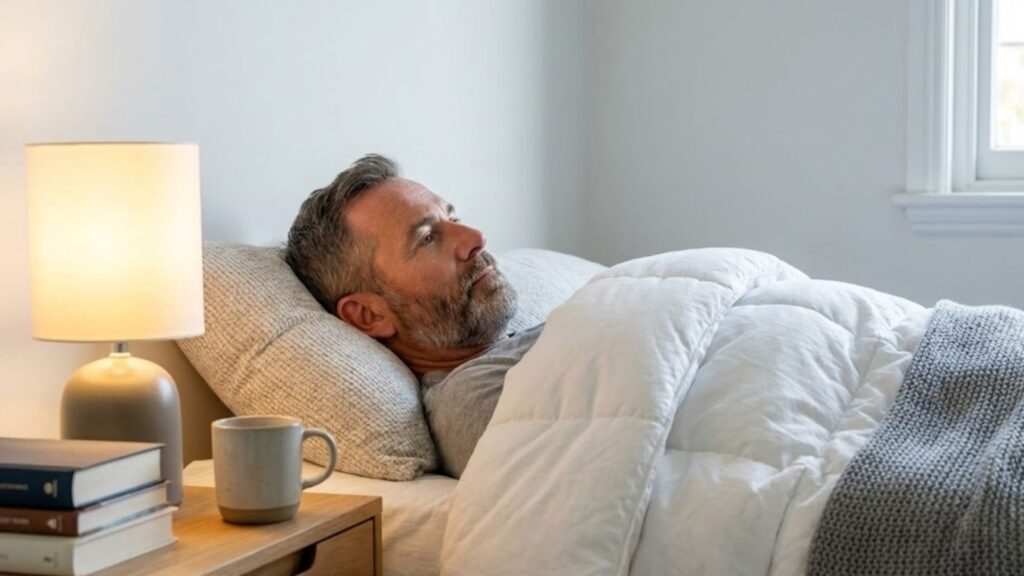
Why Switching Off Feels So Difficult
Difficulty sleeping is far more common than it appears on the surface. National survey data shows that around 14.5% of adults struggle to fall asleep, while nearly 17.8% report waking during the night and being unable to drift back off. These issues are reported more frequently by women, and night-time awakenings tend to increase with age.

Healthcare professionals often recommend Cognitive Behavioral Therapy for Insomnia (CBT-I), typically delivered across 4–8 sessions, to help reshape unhelpful sleep-related thoughts and routines. The methods discussed here are not a replacement for professional care, but they are built on the same principle: lowering arousal, calming the mind, and allowing sleep to arrive naturally instead of forcing it.

Method 1: 4-7-8 Breathing to Slow Everything Down
The well-known 4-7-8 breathing technique is a gentle way to tell your nervous system it’s time to ease off. Slow, controlled breathing — especially with longer exhales — helps guide the body toward the parasympathetic “rest and digest” state. While the exact ratio isn’t a proven cure for insomnia, it’s a simple, low-effort relaxation tool that many people find surprisingly effective.
– Exhale fully through your mouth with a soft, steady sound.
– Close your mouth and inhale quietly through your nose for a count of 4.
– Hold the breath for 7.
– Exhale through your mouth for 8, emptying your lungs.
– Repeat up to four cycles without straining.
If sleep creeps in before you finish, that’s exactly the goal. It’s especially helpful during those moments when your brain decides that 2 a.m. is the perfect time to replay every awkward memory it has ever stored.
Method 2: Progressive Muscle Relaxation From Feet to Face
Mental tension almost always brings physical tension along with it. Progressive Muscle Relaxation (PMR) works by helping you consciously tense and then release muscle groups, making it easier to notice and let go of hidden tightness. Several studies link regular PMR practice to improved sleep quality, making it a safe and practical nighttime tool.
Lie comfortably on your back and take a few slow, deep breaths. Then begin at your feet:
- Tense your feet and calves for 5–7 seconds, then release completely.
- Wait 20–30 seconds and notice the relaxed feeling.
- Move upward: thighs and hips, stomach and chest, back, hands and arms, shoulders, neck, and finally your face.
When you reach your face, gently squeeze your eyes shut and wrinkle your forehead before letting everything soften. Many people notice a heavy, sinking sensation into the mattress by the end — a clear sign the body is letting go of alertness.
Done slowly, PMR draws attention away from racing thoughts and into the physical sensation of warmth and heaviness. One or two rounds are often enough to invite that drifting, sleepy feeling.
Method 3: Gentle Mental Distraction Instead of Mental Battles
Trying to force your mind to “stop thinking” usually backfires. A more effective approach is cognitive distraction — giving the brain a simple, neutral task so worries and to-do lists don’t dominate the night.

A popular option is the alphabet game. In your head, go through the alphabet and name an item from a chosen category, such as animals:
A — alligator, B — beaver, C — cat, D — deer.
Move slowly and casually. There’s no rush and no finish line. If you forget where you were, just start again. If you fall asleep halfway through, you’ve succeeded.
This method gently redirects mental energy toward something repetitive and low-pressure, rather than fighting thoughts that can’t be resolved in the middle of the night.
Evening Habits That Help These Techniques Work
Relaxation exercises are far more effective when your overall sleep hygiene supports them. Bright light, screens, and stimulating evening habits can keep the brain in high-alert mode. Blue-heavy light, in particular, suppresses melatonin more strongly than warmer tones, which is why phones and laptops can interfere with sleep.
– Dim overhead lights about an hour before bed.
– Use warm, soft lamps instead of bright lighting.
– Put phones, tablets, and laptops away before lying down.
– Choose calm, non-screen activities like reading a paper book.
– Reserve the bed for sleep and intimacy only.
One of the biggest shifts often comes from removing work and entertainment from the bedroom. When the bed stops feeling like a second office chair, relaxation techniques tend to work much more reliably.
Bringing It All Together for Better Sleep
| Nighttime Habit | Why It Matters |
|---|---|
| Lowering room lighting about an hour before sleep | Helps maintain natural melatonin levels and cues the body to slow down |
| Avoiding phones and screens while in bed | Reduces mental stimulation and prevents the brain from linking the bed with alertness |
| Using the bed mainly for sleeping | Reinforces the brain’s association between lying down and feeling sleepy |
There’s no instant switch that guarantees perfect sleep every night. However, combining simple tools like 4-7-8 breathing, progressive muscle relaxation, and gentle mental distraction with calmer evening habits can make it easier to fall asleep and wake up feeling more refreshed.
If any of these ideas resonate, try them consistently for a few nights and notice what changes. Small adjustments often add up — and sharing what works for you could help someone else escape that familiar 3 a.m. spiral.