
The floor in your living room might not seem like the right place to build strong & defined legs. But it is always there beneath your coffee table and whatever else you have lying around. You do not need a gym membership or expensive equipment like a squat rack or dumbbells. All you need is some floor space and your own bodyweight along with the willingness to feel your muscles working in ways you might have forgotten.
Finding Strength Between the Couch and the Kitchen
Picture this: it’s early evening with a soft glow from the TV & dinner dishes drying in the rack. The day has been long and your legs feel a little stiff from sitting & maybe heavy from too many drives and not enough walks. You stand up barefoot and feel the cool surface beneath your feet. You shift your weight from heel to toe and in that simple moment you remember that your legs are not just for getting you from the car to the front door. They are your engines and shock absorbers and quiet workhorses. Americans spend frighteningly long hours sitting at desks and in cars & on couches. The result is weak glutes & tight hips and stiff knees and low-back aches that seem to appear out of nowhere. The good news is your body is remarkably forgiving. With a few simple bodyweight exercises done consistently at home you can reclaim strength and power & shape in your legs without turning your life into a boot camp or rearranging your furniture like a fitness studio. You don’t need to become a fitness person. You just need a small routine that feels like it fits naturally between brewing coffee and brushing your teeth. That routine done barefoot on your living room floor can gradually carve out stronger quads and more defined hamstrings and glutes that actually participate when you climb stairs instead of leaving all the work to your knees.

Building a Foundation: Squats Without the Gym
Let’s begin with the squat. Before anyone called it exercise it was simply how humans lived. People squatted to cook & gather food and rest. Your legs are built to bend and straighten under your body weight throughout the day but most of us avoid this movement and sit in chairs instead. Stand with your feet roughly shoulder-width apart and turn your toes out slightly as if you’re about to sit on a low bench. Let your arms reach forward for balance. Push your hips back first and then bend your knees. Lower yourself like you’re reaching for a seat behind you. Keep your weight spread through your heels and the middle of your feet instead of letting it shift into your toes. When you reach the bottom position pause for a moment & notice your thighs working while your glutes engage lightly and your core tightens. Then push through the floor and stand up tall. The first few repetitions might feel unstable as if you’re working with muscles that forgot what to do. This is normal. Go only as low as feels comfortable for your knees and hips even if that means just a few inches at first. With practice you’ll sink deeper until your thighs approach parallel with the floor & the movement becomes smoother while your breathing stays steady. This isn’t about doing it perfectly but about being present and noticing how your body moves so you can adjust as needed. If your knees cave inward try imagining that you’re pushing the floor apart with your feet. If your heels come off the ground reduce how far down you go and focus on keeping them planted. If you need extra support try a couch squat by standing in front of your couch and lightly touching it with your hips on each repetition to use it as a guide.

Progressing Your Squats
When regular squats become easy and you can complete 3 sets of 12 to 15 repetitions without much difficulty you can increase the challenge in several ways. Try tempo squats by taking 3 to 4 seconds to lower yourself down and then pausing for 1 to 2 seconds at the bottom before standing back up. Another option is pulse squats where you stay near the bottom position and perform small up and down movements for 15 to 20 seconds. You can also do squat holds by lowering yourself into a comfortable squat position and maintaining that position for 20 to 40 seconds while your muscles work hard to keep you stable.
Lunges: The Everyday Strength Secret
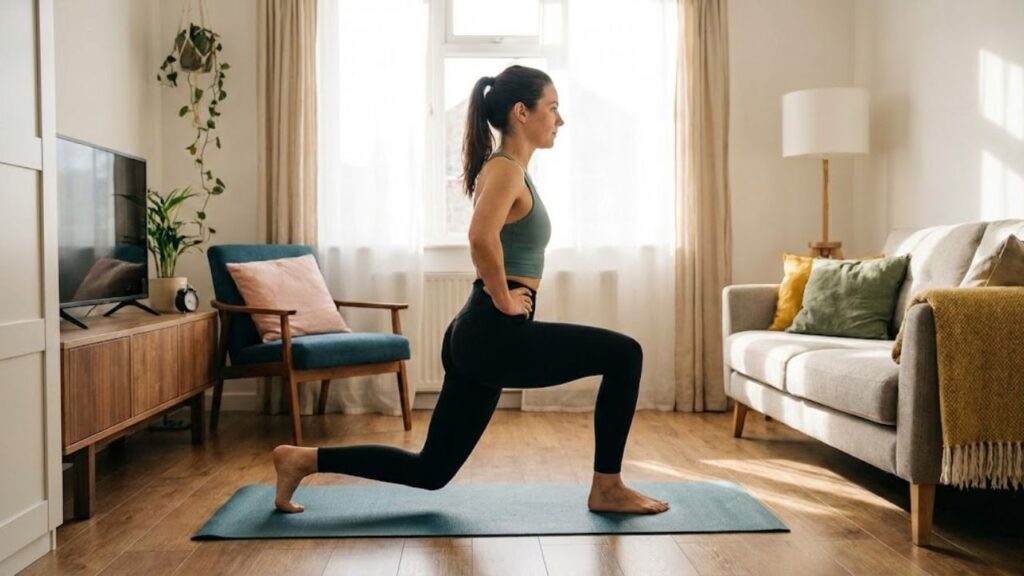
Walk up stairs. Step over the dog. Climb onto the porch. Lunges are the real-world version of these movements. They train one leg at a time & reveal imbalances you might not know about while building strength that carries over to daily activities. From a standing position step one foot forward like you’re taking a confident stride. Let your back heel lift and bend both knees. Your front knee should stack roughly over your ankle and not dramatically past your toes. Your back knee points down toward the floor. You don’t have to touch the ground but think of a gentle hover. Press through your front heel to stand back up and bring your feet together. That’s one rep. As you lower you’ll feel your front thigh working like a brake and your glute powering you back to standing. Your core stabilizes you when you wobble and most people wobble at first. It’s not a sign of weakness but your balance system waking up. If balance feels tricky keep a hand lightly on a wall or chair. You can also shorten your step and do a split squat where instead of stepping in and out you keep your feet in a staggered stance and simply lower and rise like a stationary lunge.
Glute Bridges and Hamstring Magic on the Living Room Floor
Not every effective leg exercise requires you to stand up. Some of the most beneficial movements happen while lying on your back on the floor when you realize your hamstrings need more work. Glute bridges are simple but effective. Lie on your back with bent knees & feet flat on the floor at hip-width distance. Rest your arms at your sides. Breathe in & then breathe out while tucking your pelvis slightly so your lower back touches the floor gently. Push through your heels & raise your hips upward. Your glutes will contract and your hamstrings will activate while your core keeps you stable and prevents excessive arching. Hold the top position briefly while forming a straight line from your shoulders to your knees and then lower your hips slowly. Glute bridges strengthen the posterior chain of your legs. This area helps you maintain better posture & walk with more power while supporting your lower back. Regular practice develops the curved muscle definition at the back of your thighs that many people try to achieve using gym equipment and heavy weights.

From Bridge to Single-Leg Strength
Once basic bridges feel comfortable you can increase the difficulty level. For a marching bridge you hold the bridge position and slowly lift one foot a few inches off the ground and then switch to the other foot like you are marching without moving forward. A single-leg bridge requires you to extend one leg straight out while keeping both thighs aligned and then lift and lower your hips using only the leg that stays on the ground. An elevated feet bridge involves placing your feet on a couch edge or low chair and performing the bridge from that position to engage your hamstrings more effectively. Each variation provides enough challenge to help your muscles adapt and become stronger while you remain on the same living room floor where you normally relax & check your phone.
Calf Raises, Side Steps, and the Details That Define Your Legs
The big muscles get most of the glory like the quads and hamstrings and glutes but the smaller ones support everything. Ignoring your calves and hip stabilizers and outer thighs is like rebuilding a house on wobbly stilts. A few simple moves can tighten up the details & make your legs feel more stable & defined from every angle. Calf raises might be the simplest exercise you will ever do. Stand with your feet hip-width apart and lightly hold the back of a chair or the wall if you like. Press into the balls of your feet and slowly lift your heels as high as you can like a slow silent tiptoe. Pause and then lower your heels under control. Feel the burn on the backside of your lower legs. Those are the calves that help you walk and climb & hold balance when the sidewalk is uneven or the hill is steep. To challenge yourself more you can try single-leg calf raises or do them standing on a step with your heels hanging slightly off the edge so you can lower deeper for a bigger range of motion. For the outer hips and thighs lateral movements are essential. We live most of our lives moving forward & backward but your body is built to move side to side as well especially at the hips. Try lateral steps with a mini-band around your thighs or just bodyweight if you don’t have one. Slightly bend your knees into a mini-squat and take small controlled steps to the right and then to the left while feeling the outer hips and glutes engage. If space is tight you can shuffle a few steps one way down the hallway and then back. Or lie on your side for side-lying leg raises where you keep your body in a straight line & lift the top leg a foot or so & pause and then lower. Slow & controlled. It is a surprisingly potent way to build the kind of hip strength that keeps your knees and lower back happier during everything else you do.
Putting It All Together: A Simple Home Leg Routine
One of the main obstacles is not how hard the exercise is but rather the mental exhaustion of making too many choices. You wonder what exercises to pick today and how to arrange them and how much time to spend on each one. When you simplify everything it becomes much easier to stick with the program and do it consistently until your legs feel stronger whenever you get up from a chair. This is a basic routine you can follow two or three times each week without leaving your house. You do not have to execute it exactly as written. Think of it as a general guide rather than a set of rigid rules.
| Exercise | Sets | Reps / Time | Rest |
|---|---|---|---|
| Bodyweight Squats | 3 | 10–15 reps | 45–60 sec |
| Lunges or Split Squats | 2–3 | 8–10 reps/leg | 45–60 sec |
| Glute Bridges | 3 | 12–15 reps | 45 sec |
| Calf Raises | 2–3 | 15–20 reps | 30–45 sec |
| Side-Lying Leg Raises or Lateral Steps | 2 | 12–15 reps/side | 30–45 sec |
The Quiet Transformation of Everyday Strength
Training your legs at home has a grounding quality that gym workouts often lack. You move at your own pace without comparing yourself to others or fixating on machine displays. Each session becomes about understanding your body better and gradually pushing its limits. The changes show up in everyday moments. Your thighs might feel firmer when you step outside in the morning. Walking around the neighborhood becomes easier because your legs have more spring in them. You might bend down to pick something up one day and realize how naturally your body moves into a deep squat. Building leg strength goes beyond appearance even though better muscle definition is a genuine benefit. Strong legs mean you can age without worrying as much about falls. You can carry shopping bags without your knees complaining. Playing with children or grandchildren on the floor becomes possible without struggling to stand back up. You gain control over how your body moves in your own environment on your own schedule. Your living room serves its purpose without needing any special equipment. The same floor where you relax in the evening can become where you discover what your legs can really do. There is no need for a gym membership or timer or audience. You have your bodyweight & a solid surface beneath you that stays constant and ready whenever you decide to exercise.