
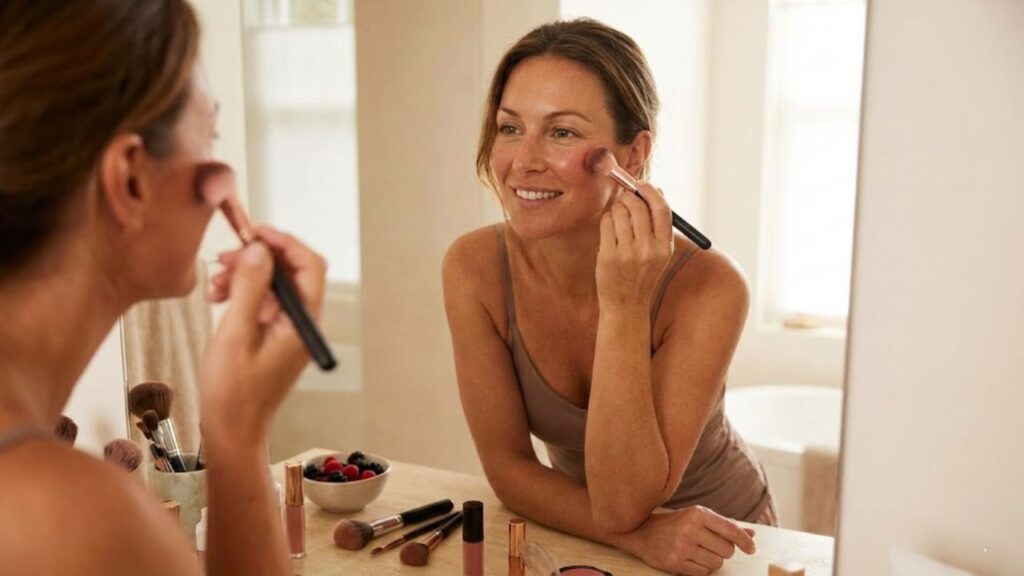
The woman looking at her bathroom mirror appears nearly identical to how she looked at 25 but not quite. Her cheeks have dropped slightly lower. The rounded areas that used to lift when she smiled now blend gently into her jawline. She picks up her trusted blush brush & follows her usual routine of smiling and applying color to the apples of her cheeks. Then she stops. The color makes her face look droopy instead of lifted. The shadows under her eyes appear darker and the middle of her face looks somewhat swollen. She removes the blush and tries again but this time places it slightly higher. Her cheekbones suddenly look more defined. Her entire face appears lifted and her eyes look more awake. She used the same blush. She is the same person. But her face looks completely different. The product did not change. What changed was where she applied it.
Why Traditional Blush Placement Suddenly Feels Wrong After 30
There’s an odd age when your makeup routine stops working as well. There’s no clear moment when it happens. You just start wondering why things don’t look right anymore when you use the same techniques that worked for years. Blush is usually the first problem. When you apply it low & round it can make a 32-year-old look tired by late afternoon. The color that used to look fresh on the apples of your cheeks now sits closer to soft lines around your nose & mouth. Instead of adding shape it just settles into those areas. That’s when changing where you put blush becomes more important than which blush you use. A makeup artist in London told me she can guess someone’s age by watching how they apply blush. Younger people put it right on the center of their cheeks like a simple drawing. People over 30 often keep doing this even though their face has changed slightly over time. She mentioned two sisters who were 28 and 38 who came to see her together. They used the same products and had similar skin tones. On the younger sister the color on the apples of her cheeks made her whole face look better. On the older sister that same spot suddenly made the slight hollows under her eyes more obvious. When the artist moved the blush higher toward the temples on the 38-year-old it looked like she had gotten a full night of sleep. The color worked like a soft filter that drew attention to her eyes & cheekbones instead of the middle of her face. The reason for this is straightforward even though people don’t talk about it much. After 30 your bone structure stays the same but the fat under your skin starts to shift. The round part of your cheek moves lower. Your muscle memory still makes you smile and follow where that round part used to be. So you end up putting color in the area that’s starting to drop. When you place blush there it makes your face look like it’s sagging. Move it slightly up and out & it makes your face look lifted. You’re not actually changing your features. You’re just changing where people look first when they see you. That’s what makes a small amount of pink blush so effective.

The Modern Blush Placement Map That Creates a Natural Lift
The Simple Blush Trick That Actually Works After 30 The makeup technique that keeps showing up everywhere right now is surprisingly straightforward. Instead of smiling & applying blush to the apples of your cheeks you should keep your face relaxed & look straight ahead. Picture a diagonal line running from the top of your ear down to the side of your nostril. Apply your blush along the upper half of that imaginary line closer to your ear than your nose. The shape should be a soft slanted C that curves toward the outer corner of your eye. Blend the color upward into your temples rather than down toward the center of your cheek. Let the color fade gradually as it moves toward your hairline like watercolor on paper. For most people over 30 this placement immediately brings out cheekbones you may have forgotten existed. There is another small adjustment that makes a noticeable difference. Leave a clean gap between your under-eye area and where the blush starts. About a finger-width of bare skin prevents color from settling into fine lines or highlighting dark circles. If you want that fresh flushed appearance you can add just a tiny bit of blush on the bridge of your nose but keep the main color high and toward the outer face. Many people over 30 share the same concern. They want a healthy glow but worry about looking overdone. The concern makes sense because one heavy application too low on the cheek can make you look flushed in an unflattering way. This is why where you put the blush matters more than how much you use. Start with less product than you think you need. Tap it on instead of sweeping it across your skin. Build up the color gradually in thin layers rather than applying one thick stripe. Cream blushes often work better on mature skin because they blend into the skin instead of sitting on top of it. Let’s be honest about real life. Nobody actually does this every day with professional brushes and twenty minutes to spare. You might be applying makeup with one hand while checking your phone with the other. So pick one simple rule you can remember on a busy morning like “higher and further back” and forget about the rest. The emotional impact is genuine too. On a tired day that slightly higher placement can make your whole face look more awake. You suddenly look like the version of yourself you still feel like on the inside. Key Points to Remember Think of an angled line instead of a circular shape when applying blush along an upward diagonal rather than as a round spot. Keep the strongest color away from your nose & mouth area. Blend upward into your temples to create a lifting effect on the outer part of your face. Choose cream or liquid formulas if powder settles into skin texture. Reassess your blush placement every few years because faces change & your routine should change with them.

How Blush Becomes a Subtle Confidence Reset With Age
There’s something quietly radical about changing how you apply a product you’ve used for 15 years. It’s like admitting that your face has changed and deciding to work with it instead of against it. One subtle diagonal stripe becomes a small act of negotiation with time. Friends talk in bathrooms about looking tired or not quite like themselves. Often it’s not their face that’s changed so dramatically but the way light & shadow now move across it. Change the splash of color and you change where the light seems to land. It’s almost philosophical because the map you draw on your skin shifts the story your face tells before you even speak. We’ve all had that moment where we catch our reflection in a shop window & think who is that. Remapping blush doesn’t erase that shock but it can soften it. The right placement whispers that you’re still in there. It doesn’t pretend you’re 22 but highlights the structure & expression you’ve earned without dragging everything downward. This simple tweak is also strangely shareable. Once you’ve tried the higher lifted placement & seen the difference it’s hard not to show a friend or your mum. You end up doing that half & half trick with one cheek the old way & one the new. The contrast usually says more than any tutorial. Blush becomes less about copying trends and more about understanding your own architecture. Where does your face want color and where does it look instantly more awake? There’s no universal diagram that fits everyone but just a guiding idea that color traveling upward tends to read as youth and energy. Color that pools in the center tends to read as fatigue. Maybe that’s why this technique keeps resurfacing on social feeds no matter how much contouring or highlighting comes and goes. It’s simple & doesn’t require new products. You’re just moving what you already own a few millimeters north.

| Astuce principale | Méthode recommandée | Bénéfice esthétique |
|---|---|---|
| Remonter la zone d’application | Déposer le blush au-dessus de l’axe oreille-nez, en direction des tempes | Donne un effet lift naturel au visage, sans chirurgie ni retouche |
| Préserver l’espace sous l’œil | Laisser environ un doigt de peau libre entre le correcteur et le blush | Atténue visuellement les cernes et limite l’accentuation des ridules |
| Favoriser les lignes obliques | Estomper le blush en diagonale plutôt qu’en cercle sur la joue | Affine les contours du visage et évite l’effet de traits alourdis après 30 ans |