
The woman studying her reflection looks almost exactly as she did at 25—but not entirely. Her cheeks sit a little lower now. The soft fullness that once lifted when she smiled blends more gently into her jaw. She reaches for her familiar blush brush and follows the habit she’s used for years: smiling and sweeping color onto the apples of her cheeks. Then she pauses.
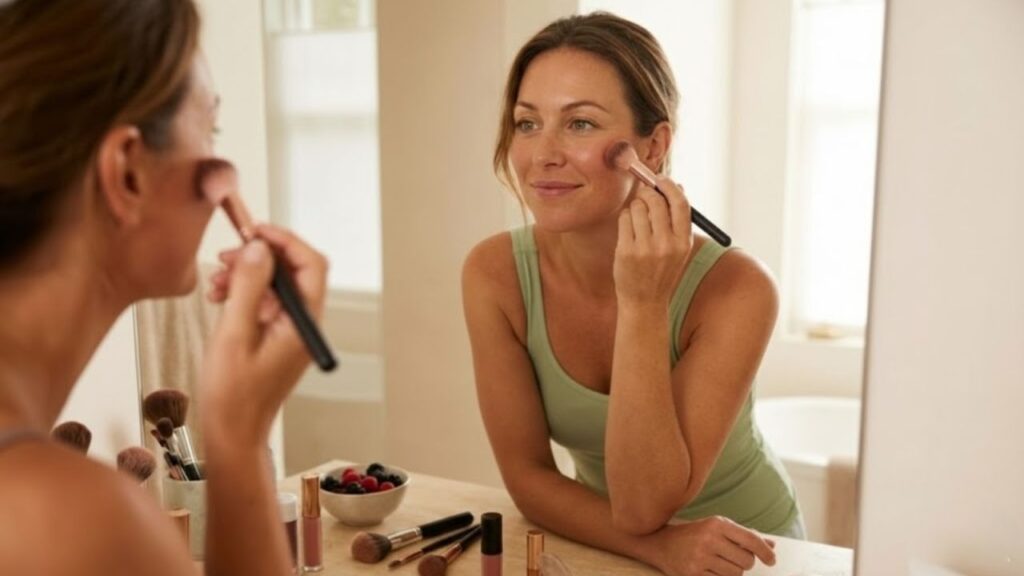
The blush makes her face appear heavier instead of lifted. Shadows beneath her eyes look deeper, and the center of her face seems slightly puffy. She wipes the color away and tries again, this time placing it just a bit higher. Instantly, her cheekbones appear more defined. Her face looks lifted, her eyes brighter. It’s the same blush, the same person. What changed wasn’t the product—it was where it was applied.

Why Blush Placement Starts Feeling Off After 30
There’s a subtle stage in life when your makeup routine stops delivering the same results. It doesn’t happen overnight. One day, you simply notice that techniques you’ve relied on for years no longer look quite right. Blush is often the first issue.

Applied low and rounded, blush can make a 32-year-old look tired by mid-afternoon. The shade that once added freshness now settles closer to soft lines around the nose and mouth. Instead of shaping the face, it draws attention to the center. At this point, placement matters more than product choice.
A London makeup artist once shared that she can often guess someone’s age just by watching how they apply blush. Younger faces naturally suit color placed directly on the center of the cheeks. Many people over 30 keep using the same method, even as their facial structure subtly shifts.
She recalled working with two sisters, aged 28 and 38. They had similar skin tones and used the same products. On the younger sister, blush on the apples of the cheeks enhanced her whole face. On the older sister, that same placement emphasized faint hollows beneath the eyes. When the artist repositioned the blush higher, closer to the temples, the older sister suddenly looked rested, as if she’d slept well. The color redirected attention to her eyes and cheekbones rather than the middle of her face.
The reason is simple. After 30, bone structure remains stable, but the fat beneath the skin gradually shifts downward. Muscle memory still guides the brush to where fullness used to be. Placing blush there highlights that movement. When the color moves slightly upward and outward, the face appears lifted. You’re not altering your features—just changing where the eye lands first.
The Modern Blush Map That Creates a Natural Lift
The technique showing up everywhere right now is refreshingly simple. Instead of smiling while applying blush, keep your face relaxed and look straight ahead. Imagine a diagonal line running from the top of your ear toward the side of your nostril. Apply blush along the upper half of that line, closer to the ear than the nose.
The shape should form a soft, angled curve that sweeps toward the outer corner of the eye. Blend upward into the temples rather than dragging color toward the center of the face. Let the pigment fade gently into the hairline, similar to watercolor spreading on paper. For many people over 30, this instantly reveals cheekbones they forgot they had.
One small adjustment makes an even bigger difference. Leave a clean space between the under-eye area and where the blush begins. About a finger-width of bare skin helps prevent color from settling into fine lines or accentuating dark circles.
If a fresh flush is the goal, a tiny touch of color on the bridge of the nose can work—but keep the main application high and toward the outer face. This approach delivers glow without looking heavy.

Many people share the same concern: wanting to look healthy without appearing overdone. That hesitation is understandable. One heavy swipe placed too low can make the face look flushed in an unflattering way. This is why placement outweighs quantity.
Start with less product than you think you need. Tap it on instead of sweeping. Build color slowly in light layers. Cream formulas often suit mature skin better, as they blend into the complexion rather than sitting on top.
Real life isn’t a makeup tutorial. Some mornings, you’re applying blush while checking your phone. So remember one easy rule: higher and further back. On tired days, that subtle shift can make your entire face look more awake—like the version of yourself you still recognize.
Key Points to Keep in Mind
- Think diagonally when applying blush, not in a circular shape.
- Keep the strongest color away from the nose and mouth.
- Blend upward into the temples to create a lifting effect.
- Choose cream or liquid formulas if powder emphasizes texture.
- Revisit your blush placement every few years as your face evolves.
How Blush Becomes a Quiet Confidence Reset Over Time
There’s something quietly powerful about changing how you apply a product you’ve used for over a decade. It’s an acknowledgment that your face has changed—and a decision to work with it. A single angled stroke becomes a small negotiation with time.
Friends often talk about looking tired or unlike themselves. Often, it’s not dramatic change but how light and shadow now move across their features. Shift the color, and you shift the light. The placement you choose subtly shapes the story your face tells before you speak.
We’ve all caught our reflection unexpectedly and wondered who we’re seeing. Adjusting blush placement doesn’t erase that moment, but it softens it. It highlights the structure and expression you’ve earned without pulling everything downward.
This simple tweak is also easy to share. Once you see the difference, it’s hard not to show someone else—doing one cheek the old way and one the new. The contrast often says more than any tutorial.
Blush becomes less about trends and more about understanding your own facial architecture. Where does color make you look instantly more awake? While no single diagram fits everyone, one principle holds true: color that moves upward suggests energy. Color that settles in the center often suggests fatigue. That may be why this technique keeps resurfacing. It doesn’t require new products—just moving what you already own a few millimeters higher.

Practical Placement Guide
- Lift the application zone: Apply blush above the ear-to-nose axis, toward the temples, for a natural lifting effect.
- Preserve under-eye space: Leave about one finger of bare skin to soften the appearance of dark circles and fine lines.
- Favor angled lines: Blend blush diagonally rather than in a circular motion for a more refined look.
