
Mary is 74, a cardigan resting on her shoulders, bright eyes, and a careful way of placing her bag as if negotiating with her body for the day ahead. Her activity tracker proudly shows 10,000 steps, yet she laughs softly while admitting she struggles to rise from a chair without gripping the table. At the gym, she was offered a shiny “senior program” filled with heavy, complicated machines. It felt overwhelming. So she sticks to the treadmill, again and again. Still, when she bends to pick up a dropped pot, her knees protest more than they did after forty minutes of walking. Something doesn’t add up. And it’s not just about how many steps she takes.
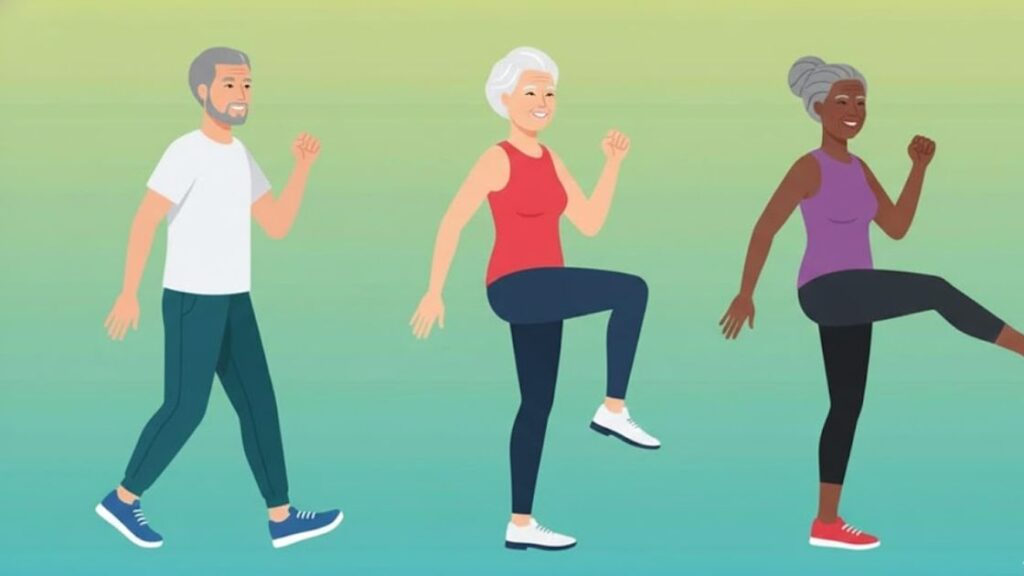
After 70, the body needs the right movement, not just more exercise
After 70, the body follows different rules. You can walk daily, even visit the gym twice a week, and still feel unexpectedly fragile when folding laundry or stepping off a high curb. That’s because most traditional exercise overlooks what truly shapes daily life: how joints, muscles, and reflexes work together in real time. The kind of movement that truly supports healthspan at this age isn’t about sweating harder. It’s about movement patterns.

Longevity researchers now speak less about “fitness” and more about maintaining capacity. Can you rise from the floor without help? Turn to check behind you in the car? Catch yourself if you stumble on a rug? These moments matter more than any indoor cycling session. They rely on one key skill: coordinated, multi-directional movement that keeps the nervous system alert.
The movement pattern that quietly changes everything
The pattern that makes the biggest difference after 70 isn’t the daily walk or the weekly gym routine. It’s what some physiotherapists call integrated movement practice: short, regular moments of bending, reaching, turning, stepping, and getting up, woven into everyday life. Think of it as a simple choreography of real living. Not elegant. Not impressive. Just deeply useful.
In a community hall in Leeds, ten people aged 71 to 89 move slowly in a loose circle. There are no mirrors, no flashy outfits, just chairs against the wall and a quiet radio. The instructor, a former nurse, doesn’t talk about workouts. She talks about getting off a bus before it moves or lifting a grandchild without back pain. Each exercise mirrors daily life, broken down and practiced until it feels natural again.
Why real-life movement matters more than machines
They practice stepping sideways and backward, not just forward like on a treadmill. They sit and stand from chairs of different heights, arms crossed. They reach for imaginary high cupboards and low drawers, sometimes holding a small weight, sometimes just a bottle of water. After eight weeks, few are “fitter” on paper. But several report fewer near-falls. Two can kneel in the garden again. One 82-year-old quietly shares that he can now get up from the floor alone for the first time in years.
The science behind this is simple. Repetitive movements like straight-line walking allow the brain to switch to autopilot. Integrated movement demands constant micro-adjustments: ankles respond, hips rotate, eyes scan, hands search for balance. It trains the nervous system and stabilizing muscles together. That’s why someone walking 8,000 steps a day can still fall in the kitchen, while another who practices controlled turns and chair squats stays upright. After 70, healthspan is less about cardio and more about being adaptable rather than brittle.
A simple daily pattern that supports independence
The pattern itself is almost deceptively simple. Three times a day, five minutes each, of multi-plane functional movement. No special clothing. No machines. Just you, a chair, maybe a wall or a step. Mornings focus on gentle wake-up moves: slow sit-to-stands, ankle circles, supported heel raises at the counter. Midday brings reach-and-turn movements, touching high and low points on a wall, then rotating as if checking behind a car seat.
Evenings are for practicing getting down and back up, at a level that feels safe. For some, that’s partial squats to a high stool. For others, it’s kneeling on a cushion, placing a hand on the floor, and returning to sitting. The power lies in the pattern: bending, straightening, rotating, stepping sideways, then returning to stability. Over time, these small sessions retrain the body to see movement in all directions as normal, not dangerous.

How to make it work in real life
Very few people stick to this if it feels like a strict program. So instead, you borrow moments. Two sit-to-stands every time you rise from the couch. A balance check while the kettle boils. One supervised floor-to-chair practice once or twice a week. The goal isn’t pushing limits. It’s turning your home into a quiet training space for the next ten or twenty years.
Alain, 76, learned this after a small bathroom fall led to a long hospital stay and talk of assisted living. His physiotherapist started with one task: standing up from a chair without using the armrests, three times, twice a day. It took weeks. Then they added side-steps along the counter, slow turns, and gentle lunges to reach low shelves. Two years later, he still dislikes treadmills, but he walks to the bakery, kneels to tend plants, and hasn’t fallen again. His body now remembers the pattern before panic.
Why this approach protects healthspan after 70
On a broader scale, this isn’t anecdotal. Studies on multicomponent exercise combining balance, strength, coordination, and gait show fall reductions of up to 30–40% compared with walking alone. The biggest gains are functional: faster walking speed, more confidence on stairs, and less fear of bending down. Fear quietly shrinks life after 70. Integrated movement chips away at that fear, day by day.
Turning movements into habits, not chores
The most effective setup isn’t a large printed routine. It’s a system of micro-rituals. Choose four movements: sit-to-stand, side-step, reach-and-turn, and one form of down-and-up. Attach each to something you already do. Before making tea, add two sit-to-stands. On the way to the bathroom, shuffle sideways along the wall. Once a day, reach high and low on a wall. Once or twice a week, practice your version of getting down and up, with support if needed.
What stops most people isn’t laziness. It’s fear—of falling, of looking foolish, of doing it wrong. Others push too hard after watching impressive videos, end up sore, and decide their body “can’t handle it.” Usually, the movement was fine; the dose wasn’t. Integrated movement should feel slightly challenging, never frightening. It should leave you more alert, not exhausted.
A longer life needs a body that can move through it
Medicine can extend years, but it can’t replace the confidence of turning quickly when someone calls your name or kneeling beside a grandchild without worry. That confidence is built through small, sometimes awkward movements repeated until the body no longer treats them as threats.
The pattern that matters after 70 doesn’t look heroic. It looks like standing up and sitting down a few extra times before leaving the table. Turning the head slowly at a bus stop. Taking an extra minute in the hallway, feeling how feet and hips adjust. On paper, it seems insignificant. In real life, it’s the blueprint for independence.

Key practices and why they matter
- Prioritise sit-to-stand strength: Practice rising from a normal chair without using your hands, 3–5 repetitions at a time, several times a day. This supports safe transfers from chairs, toilets, and cars.
- Add side-steps to daily movement: Walk sideways along a wall or counter for a few steps and back. Most falls happen sideways, not straight ahead.
- Train a safe “down and up” level: Choose a version you can manage and repeat it weekly. This reduces panic after slips and keeps activities like gardening possible.
- Use habits as triggers: Attach movements to daily routines so they become automatic and sustainable.
