
Mary is 74. A cardigan rests on her shoulders, her eyes are alert, and she places her handbag as if she’s already negotiating with her body for the day ahead. Her fitness tracker proudly shows 10,000 steps, yet she laughs softly as she admits she struggles to rise from a chair without gripping the table. At the gym, she was offered a glossy “senior programme”—machines that felt too heavy, too complex, too disconnected from real life. So she sticks to the treadmill, again and again. Still, when a pan slips to the floor, her knees protest more than after forty minutes of walking. Something doesn’t add up. And it’s not just about steps.
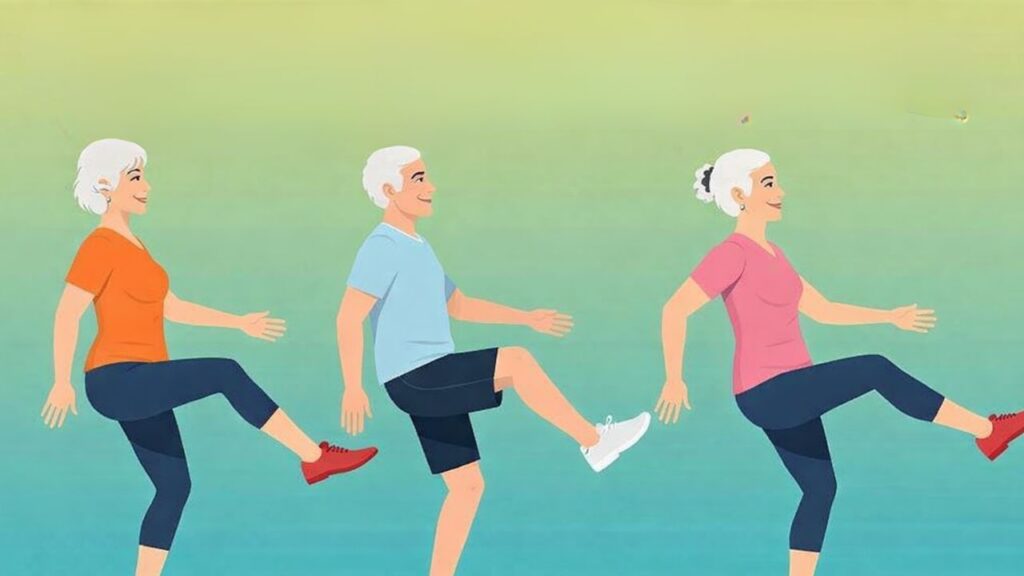
After 70, the body needs smarter movement, not simply more exercise
Once you pass 70, the body starts playing by different rules. You can walk daily or visit the gym twice a week and still feel unexpectedly fragile while sorting laundry or stepping off a curb. That’s because most traditional exercise skips what truly shapes everyday independence: how joints, muscles, balance, and reflexes work together in real time. At this stage, what supports healthspan isn’t sweat or intensity—it’s movement patterns that reflect real life.

Researchers now talk less about “fitness” and more about maintaining capacity. Can you stand up from the floor without help? Turn to look behind you while driving? Catch yourself if you trip on a rug? These moments matter far more than any stationary bike session. All of them depend on one quiet skill: coordinated, multi-directional movement that keeps the nervous system responsive.

The movement pattern that makes a real difference after 70
The approach that quietly transforms life after 70 isn’t the daily walk or a demanding gym routine. It’s what many physiotherapists call integrated movement practice. This means short, frequent moments of bending, reaching, turning, stepping, and rising—woven naturally into the day. Think of it as teaching your body a simple choreography of everyday life. It’s not elegant or photogenic. It’s deeply practical.
In a community hall in Leeds, ten people aged between 71 and 89 move slowly in a loose circle. No mirrors. No Lycra. Just chairs pushed aside and soft music in the background. The instructor, a former nurse, avoids the word “workout.” Instead, she talks about getting off a bus before it moves or lifting a grandchild without back pain. Each movement mirrors daily tasks—broken down, practiced, then reassembled.
Small changes, meaningful results
The group practices stepping sideways and backward, not just forward like on a treadmill. They sit and stand from chairs of different heights with arms crossed. They reach up toward imaginary cupboards, then down to low drawers, sometimes holding a small weight, sometimes just a water bottle. After eight weeks, their test scores don’t shout “fitness.” But the changes matter. Several report fewer near-falls. Two can kneel in the garden again. One man, 82, quietly shares that he can now rise from the floor on his own for the first time in years.
The science behind this is straightforward. Straight-line walking or machine cycling is repetitive and predictable, allowing the brain to switch to autopilot. Integrated movement forces constant micro-adjustments: ankles respond, hips rotate, eyes scan, hands search for balance. This trains the nervous system and stabilising muscles together. That’s why someone walking 8,000 steps daily may still fall in the kitchen, while another who practices controlled chair squats and slow turns stays upright. After 70, it’s less about cardio and more about being adaptable rather than brittle.
A simple daily pattern that supports long-term independence
The pattern itself is almost deceptively simple. Three times a day, five minutes each, of what therapists call multi-plane functional movement. No special clothing. No machines. Just you, a chair, maybe a wall or a step. Mornings focus on gentle wake-up movements—slow sit-to-stands, ankle circles, supported heel raises at the counter. Midday is for reaching and turning—touching a high spot on the wall, then a low one, then rotating as if checking behind a car seat.
Evenings are for practicing “down and up” movements at a safe level. For some, that’s partial squats to a high stool. For others, kneeling on a cushion, placing a hand on the floor, and returning to sitting. The value lies in the sequence: bend, straighten, rotate, step sideways, then return to stable. Over time, these brief sessions quietly retrain the body to see movement in all directions as normal, not threatening.
Turning everyday life into gentle training
Let’s be honest: almost no one sticks to this if it feels like a military plan. So instead, you borrow moments. Two sit-to-stands every time you rise from the sofa. A balance drill while the kettle boils. One slow floor-to-chair practice once or twice a week, supervised if needed. The aim isn’t heroics. It’s turning your home into a quiet training space for the next ten or twenty years.
Alain, 76, learned this the hard way. After a minor bathroom fall led to a long hospital stay, he was told it might be time to consider assisted living. His daughter found a physiotherapist who refused to accept that verdict. They began with one task: standing up from a chair without using the armrests, three times, twice a day. It took weeks. Then came sideways steps along the counter, slow turns, gentle lunges to reach low shelves. Two years later, he still avoids treadmills—but he walks to the bakery, kneels to care for plants, and hasn’t fallen again. His body remembers the pattern before panic appears.

Why this approach works on a larger scale
This isn’t just anecdotal. Research on multicomponent exercise—combining balance, strength, coordination, and gait—shows fall reductions of up to 30–40% compared with walking alone. Cardiovascular benefits remain, but the biggest gains are functional: faster walking speed, more confidence on stairs, and less fear of bending down. Fear quietly shrinks lives after 70. When people stop turning, bending, or stepping sideways “just in case,” their world narrows. Integrated movement gently pushes back against that fear, day by day.
How to build this pattern into real life
The most effective version isn’t a large, rigid plan on the fridge. It’s a micro-ritual system. Choose four movements: sit-to-stand, side-step, reach-and-turn, and one form of down-and-up. Attach each to something you already do. Standing up to make tea? Add two slow sit-to-stands. Walking to the bathroom? Side-step along the wall for a few steps, then return.
Once a day, practice reaching high and low—one hand sliding up a wall, the other down your thigh, then switch. Once or twice a week, with someone nearby, practice your chosen down-and-up movement. You’re not training for sport. You’re rehearsing daily life so it stops catching you off guard.
What stops most people isn’t laziness—it’s fear. Fear of falling, of looking awkward, of doing it wrong. So they walk, because walking feels safe and respectable, and avoid everything else. The other trap is doing too much too soon. Integrated movement should feel gently challenging, never frightening. It should leave you feeling more alert, not exhausted.
Small movements, lasting freedom
Gripping the stair rail more tightly than before isn’t failure—it’s information. It shows where to begin. Chairs, tables, and walls are allies, not signs of weakness. Talking about these practices also matters. Saying, “I’m practicing getting up from the floor so I can keep playing with my grandchildren,” shifts the story from decline to training for life.
As one experienced physiotherapist puts it, the goal isn’t to make older adults “fit,” but to make them hard to knock over and easy to get back up. That philosophy starts small, with movements tied to goals that matter—gardening, hanging laundry, climbing bus steps without fear. Without that connection, exercises become chores. With it, they become preparation for a life you’re not ready to give up.
Living longer is not the same as living well
Modern medicine can extend years, manage blood pressure, regulate sugar, and protect the heart. What it can’t prescribe is the quiet confidence of turning to answer a call, kneeling beside a grandchild, or standing up without hesitation. That confidence is earned through repetition of small, slightly awkward movements until the body no longer treats them as danger.
The pattern that matters after 70 doesn’t look heroic. It looks like standing up and sitting down before leaving the table. Like slowly turning your head at a bus stop. Like taking an extra minute in the hallway, sliding a hand along the wall, feeling how your feet and hips cooperate. On paper, it seems insignificant. In reality, it’s the outline of another decade lived on your own terms.
The question isn’t whether to walk or visit the gym—you can keep those. The real question is where, in your actual day, you can quietly practice bending, turning, stepping, and rising. Which chair becomes your partner? Which moment becomes your cue? Healthspan isn’t reserved for experts. It lives in those five-minute spaces between daily tasks, shaped by how you choose to move today.

- Prioritise sit-to-stand strength: Practice rising from a standard chair without using your hands, 3–5 repetitions at a time, several times daily. Adjust height or support as needed and reduce gradually. This supports independence in daily transfers.
- Add side-steps to hallways: Walk sideways along a wall or counter for 5–10 steps, then return, once or twice a day. This trains balance in the directions where most falls occur.
- Practice a safe down-and-up movement: Choose a manageable version—from stool to chair or kneeling with support—2–3 repetitions, once or twice weekly. This reduces fear and supports recovery after slips.
- Use daily habits as cues: Link movements to routines like watching TV, boiling the kettle, or getting out of bed. This makes the practice automatic and sustainable.
