
Within just a few weeks, the couple found themselves calling their designer again, asking whether the kitchen could feel less rigid and more like a living room that also happens to cook. That quiet request reflects a broader shift now spreading through high-end interiors. Designers are already pointing to 2026 as the moment when our long-standing devotion to the kitchen island starts to fade. In its place, something far more adaptable is stepping forward.
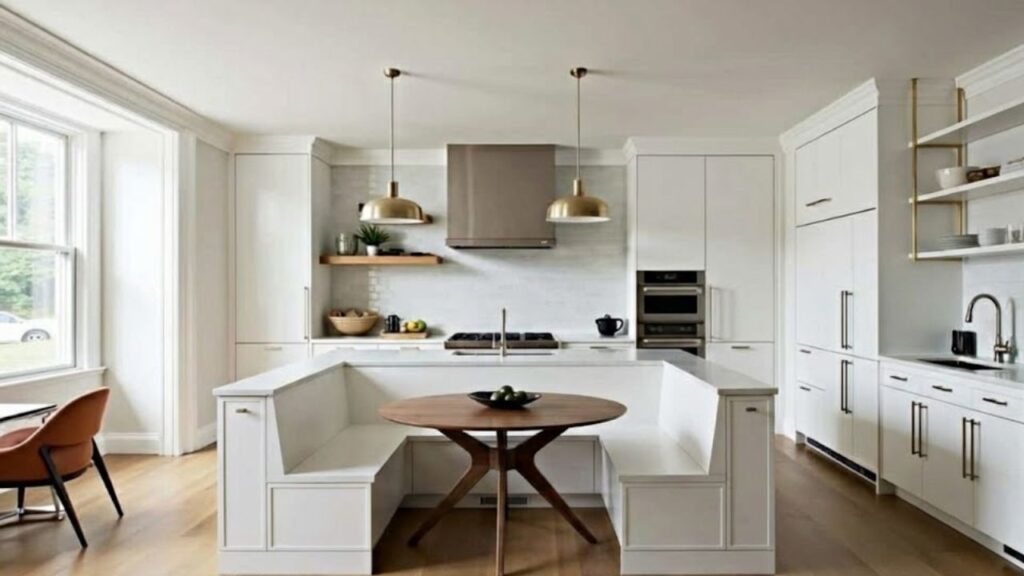
Why designers are moving away from the traditional kitchen island
Step into almost any suburban show home built over the past two decades and the scene is familiar: a large, immovable island planted in the centre of the kitchen, dominating the room like a parked SUV. What began as a design choice gradually became a default. Now, designers are pushing back, arguing that this single, oversized block disrupts circulation, limits conversation, and in smaller homes, even steals precious daylight.

The growing preference is for a more refined and practical solution: kitchen worktables paired with modular peninsulas. These slimmer, often movable pieces can act as a dining table, prep surface, or casual bar without anchoring the room in place. They prioritise how people actually move and live, quietly transforming kitchens into spaces meant for lingering, not just passing through.

Recent European projects make the shift obvious. In a compact London terrace, designer Laura Jackson replaced a planned quartz island with a narrow oak worktable on discreet casters. With drawers on one side and stools on the other, it can be rolled toward the window for weekend brunch and slid back for evening prep, adapting effortlessly to daily routines.
A 2025 Houzz survey already signals what lies ahead. Among homeowners planning renovations, 38% said they would consider a movable worktable instead of a fixed island, especially in kitchens under 18 square metres. Architects report that many clients initially request an island, only to change their minds once alternatives are drawn to scale, revealing how much space the traditional island quietly consumes.
The reasoning is straightforward. Classic islands emerged in expansive American kitchens where filling space was the challenge. By 2026, the pressure has reversed: every square metre must perform multiple roles. A fixed block struggles to shift from homework station to buffet table to quiet coffee spot without friction.
Worktables and slim peninsulas offer flexibility. They allow the room to adapt around daily life rather than forcing routines to bend around a fixed object. Designers also note a behavioural change: when the centre of the kitchen resembles a welcoming table instead of a stone fortress, people naturally gather rather than orbit the edges.
The 2026 alternative: adaptable worktables and refined peninsulas
The emerging “anti-island” movement isn’t about leaving the kitchen centre empty. It’s about replacing immovable mass with intentional movement. The standout layout for 2026, according to many studios, pairs a generously sized worktable with integrated storage alongside a low-profile peninsula anchored to one wall.
The worktable becomes the heart of daily life. One side handles chopping and prep, the other holds a laptop and coffee, while friends lean casually on the corners with a glass of wine. Meanwhile, the peninsula discreetly conceals appliances, plumbing, and power without cutting the room in half. Where the old island demanded attention, this combination adapts quietly.
Anyone who has hosted knows the awkward crowding around an island, stools bumping and paths blocked. New layouts soften those edges by positioning worktables slightly off-centre and keeping clear, generous routes between fridge, sink, and oven.
In a Copenhagen flat visited last autumn, the “island” was actually a long, narrow walnut table with a heat-resistant stone strip running through its centre. With just two drawers and a hidden power outlet, meals flowed seamlessly from cooking to eating to lingering. As the homeowner joked, “We stopped shouting across the island. We just sit down.”
Perfect batch-cooking setups may look beautiful online, but real counters quickly disappear beneath mail, chargers, shopping bags, and half-unpacked groceries. A bulky island often becomes a clutter magnet. A more agile layout makes resetting the space feel natural rather than exhausting.
Roll the worktable out when extra surface is needed. Pull stools around the peninsula for a spontaneous breakfast. Tuck a slim bench underneath to let the room breathe. Designers say this flexibility doesn’t just change how the kitchen looks, it changes how relaxed it feels on an ordinary weeknight.
Practical design principles for a post-island kitchen
Shifting from a fixed island to a worktable typically means choosing a piece 70–90 cm wide and 140–200 cm long, with drawers on one side and legroom on the other. Durable surfaces such as oiled wood, compact laminate, or stone insets work best, ideally paired with discreet locking casters. This creates prep space, dining space, and a social hub in one adaptable element.
 Goodbye Pressure Cookers: Safety Reviews Push Families Toward Smarter Automated Cooking Appliances
Instead of adding a second bulky island, designers recommend a slim peninsula attached to a wall or tall cabinet run. At just 45–60 cm deep, it preserves openness while housing plumbing, bins, or dishwashers beneath. The result is a functional cook zone without carving the room into tight corridors.
Circulation remains crucial. Leaving at least 100–110 cm between worktables, peninsulas, and surrounding cabinetry helps prevent the cramped feeling so many oversized islands create. In busy family kitchens, stretching this to 120 cm makes shared cooking far more comfortable.
How to plan a kitchen without an island that truly works
Designers advise starting on the floor rather than on Pinterest. Use masking tape to outline the footprint of your current or planned island, then tape out a slimmer worktable and a short peninsula. Walk your usual routes: fridge to sink, sink to hob, oven to table. Mimic opening doors and carrying hot trays. The room quickly reveals where it tightens and where it opens up.
Once flow is clear, choose one element to feel genuinely beautiful, often the worktable. Treat it like furniture rather than cabinetry, with rounded corners, visible legs, and warmer finishes that visually connect to the living area.
The peninsula can remain discreet and highly functional, hiding bins, handles, and appliances behind clean lines. This balance allows one piece to feel domestic and the other technical, helping the kitchen read as a place to stay rather than a row of machines.
Most kitchen regrets stem from overbuilding: too much stone, too many tall units, an island that impresses on a moodboard but overwhelms in daily life. Designers consistently caution against treating an island as proof of a “proper” kitchen. Starting from real habits often leads to calmer, more usable spaces.
There’s also an emotional dimension. A solid island can feel like a barrier between the cook and everyone else, while a table naturally draws people closer. One Melbourne designer measures success by sound, noting that overlapping conversations around the table signal a kitchen that truly works.
As one New York designer put it, “We’re moving from the kitchen as a monument to the kitchen as a conversation. The island was a pedestal. The worktable is an invitation.”
- Avoid overhangs deeper than 30 cm to reduce clutter and wasted space.
- Keep at least one side of the worktable fully leg-friendly for everyday meals.
- Hide power connections within bases rather than placing visible strips on surfaces.
- Mix finishes by pairing one furniture-style element with one tougher, kitchen-grade surface.
Life after the kitchen island
The gradual end of the kitchen island era isn’t about rejecting marble or thoughtful design. It reflects kitchens finally aligning with how people live in 2026: working from home at irregular hours, eating quickly one day and lingering the next, hosting crowds one weekend and reheating soup the following night. A fixed block at the centre simply can’t keep pace.
The emerging alternative is quieter and more human. A generous worktable where laptops, pasta bowls, colouring books, and wine glasses coexist without ceremony. A slim peninsula handling the technical tasks without demanding attention. Less spectacle, more life.
Some homeowners will still choose islands, and that’s perfectly fine. Trends aren’t rules. What designers are really highlighting is choice. When the heart of the kitchen starts to feel like a table again, something softens throughout the home.
Perhaps the real farewell isn’t to the island itself, but to the idea that a kitchen must revolve around a single, immovable object. The new approach favours layouts that evolve, allow mess, invite conversation, and leave room for surprise. Years from now, few will remember the name of the stone, but many will remember who was sitting around that table when it mattered most.