
The stairs you see every day are ordinary steps until you turn them into a powerful leg training tool. That park bench might seem like a spot to sit down but you can use it for squats or step-ups to build leg strength. The floor in your living room offers more workout possibilities than costly gym equipment when you learn to use your body weight effectively. You don’t need a gym membership or special gear. All you need is gravity and the decision to get stronger using what you already have around you.
Strength Starts at Home: The Power of Bodyweight Leg Workouts
Stand barefoot in an open space and feel the floor beneath your feet. It is steady, cool, and indifferent. Spread your toes slightly and shift your weight from heel to forefoot. Your legs are the quiet pillars that carry you from bed to coffee maker to bus stop, constantly calculating to keep you balanced. Bodyweight leg training begins here, in the simple dialogue between your feet and the ground. Removing machines and heavy weights doesn’t reduce effectiveness—it removes excuses. The work becomes simpler and more honest. Squat, lunge, hinge, push, jump, and balance. These movements predate gyms, sports, and even the word “workout.” Think of bodyweight leg training not as a gym routine but as sharpening your ability to move through the world with strong, aware muscles. Hills, stairs, and even standing in line can become part of the practice. The benefit extends beyond quads and calves—it’s knees that feel stable on rocky trails, hips that move without pain, and a body that acts as a partner, not a burden.

Waking Up Your Legs: Preparing Muscles for Action
Before your legs push, pull, and burn, they need to wake up. This isn’t about bouncing stretches but small, intentional movements signaling that something important is coming. A bodyweight leg warm-up requires only a few square feet and focused attention. Start by marching in place for a minute, swinging your arms, letting your heels softly touch the floor. Slowly circle each ankle, drawing invisible moons in the air. Gently bend and circle your knees, coaxing them into a full range of motion. Walk your hands down your thighs into a light forward fold with knees slightly bent, letting your hamstrings awaken. Finish with a few shallow bodyweight squats, noticing how your hips and knees move today. Some days they glide, some days they complain—both are fine. This warm-up is part of your workout’s story, where hips, knees, ankles, and balance introduce themselves. Skip it, and the story never makes sense.
Using Gravity as Resistance: Core Movements for Strong Legs
Bodyweight leg training is like cooking with simple ingredients: when approached carefully, it’s effective, adaptable, and satisfying. You don’t need dozens of exercises—just a small set of foundational movements to refine over time. Begin with exercises you already know. Squats teach controlled sitting and standing, while lunges improve balance and one-legged movement.
Bodyweight Squats: Building Strength from the Ground Up
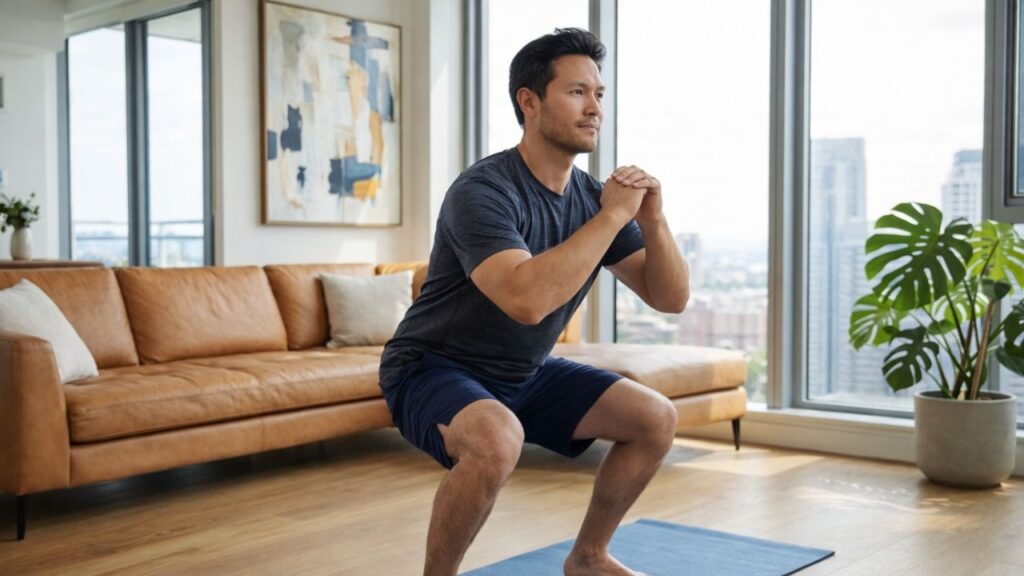
Stand with feet shoulder-width apart. Imagine sitting back into a chair slightly farther than usual. Hips move backward, knees bend, chest stays upright. Weight rests on your heels while toes maintain contact with the floor like roots. Pause briefly at the bottom and breathe. Feel your quadriceps, glutes, and hamstrings. Rising up, press deliberately against the floor. Once squats feel easy, increase difficulty by slowing down, holding the bottom position, or adding pulses. Equipment isn’t necessary—tempo and control create enough challenge.
Controlled Lunges: Developing Balance and Stability
Lunges turn everyday walking into focused strength work. Step one foot forward, bend both knees while keeping your front knee over the foot, and lower the back knee gently toward the floor. Maintain a straight upper body and look ahead. Press through the front leg to return upright, then switch sides. Notice differences between your legs—they provide feedback on areas needing attention. Variations like walking lunges or reverse lunges change the challenge and protect your knees. Lunges teach your hips to stabilize and your feet to adjust, strengthening movement control over raw force.
Glute Bridges: Engaging the Posterior Chain
Lie on your back with knees bent and feet flat. Press your lower back lightly toward the floor, then lift your hips until your body forms a straight line from shoulders to knees. Squeeze your glutes at the top, hold briefly, and lower slowly, vertebra by vertebra. This works your glutes and activates the posterior chain supporting hips and lower back. Progress to single-leg bridges to increase intensity without weights, relying on your body and gravity alone.

Calf Raises: Strengthening Often-Neglected Muscles
Stand with feet hip-width apart, resting a fingertip on a wall or chair for balance. Rise onto the balls of your feet, lifting heels as high as possible. Hold, then lower slowly. Your calves act as shock absorbers and springs, improving climbing, hiking, and running. Elevate your feet on a step to expand range of motion for added challenge.
Step-Ups: Turning Everyday Objects into Strength Tools
Use a stable surface like a bench, chair, or low wall. Step up with one foot, press through it to stand tall, bring the other foot up, then step down carefully. Step-ups engage the leg fully from hip to calf, mirroring real-world movements like climbing vans or stairs. Increase difficulty by using higher surfaces, slower tempos, or pausing at the top to test balance.
Progressing Without Weights: Smart Ways to Challenge Your Legs
Bodyweight training can still plateau without added resistance, but reps, leverage, and tempo can provide continuous growth. Increase reps, sets, or transform squats into jump squats. Explore one-leg pistol squat progressions with support. Tempo challenges muscles by slowing movements, e.g., a nine-second squat with pauses at the bottom. Leverage adjustments, such as elevated feet for glute bridges or steps during lunges, intensify effort. None of these require equipment beyond your surroundings, yet each tweak drives adaptation.
| Exercise | Sets | Reps / Duration | Focus & Tips |
|---|---|---|---|
| Bodyweight Squats | 3 | 10–15 reps | Perform each rep slowly, keep feet shoulder-width apart, and pause briefly at the bottom. |
| Reverse Lunges (Each Leg) | 3 | 8–12 reps | Step backward carefully to protect the knees; maintain an upright torso and steady core. |
| Glute Bridges | 3 | 12–15 reps | Press firmly through your heels, squeeze glutes at the top, and lower slowly. |
| Step-Ups (Each Leg) | 2–3 | 8–10 reps | Use a stable platform; focus on controlled movement while stepping down. |
| Standing Calf Raises | 3 | 15–20 reps | Raise heels fully, hold at the top for a second, then lower slowly for better activation. |
Simple Bodyweight Leg Routine
No complex plan is needed. Choose a few exercises, commit to performing them several times a week, and focus on quality over quantity. Rest 45–75 seconds between sets. Adjust reps to ensure the last few are challenging but maintain perfect form. Progress by increasing reps, sets, slowing movement, or trying advanced variations like jump squats, Bulgarian split squats, or single-leg bridges.
Transforming Everyday Spaces into a Leg Gym
Look around—the world is filled with training tools. Curbs become platforms for calf raises, low walls for step-ups, tree branches for gentle leg swings. Sidewalks, park benches, and apartment steps can all integrate into training. On a walk, convert the last block into a mini workout: stop for 10 squats, step-ups, or calf raises. Bodyweight training is free, convenient, and versatile. It blends workouts with daily life. Legs trained this way are ready for hikes, long days on foot, or spontaneous sprints. Strength without equipment isn’t a compromise—it reconnects you to your body and the ground beneath you, building trust and capability step by step.